
Brand Voice for Service Firms: 5 Exercises for Better Fit Leads
Define a distinct brand voice for your service firm with practical workshop exercises, homepage messaging guidance, and tests that track inquiry quality.

Written by Thiam Hock NgFounder
15 min read
Brand voice for services is the consistent personality your firm uses in every word a buyer reads, from the homepage to the proposal. Your first move is simple: pick three voice attributes, then map them onto the messaging hierarchy of your homepage. The rest of this guide gives you a framework, workshop exercises, and ways to test whether the voice is working.
TL;DR:
- Choose three to five voice attributes, define each as we are X but never Y, and prove every trait with a sentence on your site.
- Rate formality, humor, respectfulness, and enthusiasm for each channel; keep the voice stable while shifting tone for proposals, support, and social media.
- Build vocabulary from support tickets, winning proposals, reviews, sales notes, and new client emails; repeated customer phrases are more useful than clever wording.
- Test one element at a time, then judge qualified calls and closed work after several weeks; raw enquiries may fall as quality rises.
Table of Contents
- What is the difference between brand voice and tone?
- Why does brand voice matter for trust and conversions?
- How do you define your service firm’s brand voice step by step?
- What workshop exercises surface your voice quickly?
- How do you apply your voice across homepage, proposals, email and support?
- How do you test and measure whether your voice is working?
- What are the most common brand voice mistakes, and how do you fix them?
- Why should service firms treat voice as a conversion lever?
- How can we help you get your voice onto the page?
- FAQ
- Sources
What is the difference between brand voice and tone?
Voice is who you are. Tone is how that personality adjusts to the moment. A firm that is “direct, reassuring and expert” keeps those three traits whether it is writing a homepage headline or an apology email. What changes is the dial settings: the apology gets softer, the pricing page gets firmer.
The Nielsen Norman Group describes four tone dimensions that work well as a planning matrix:
- Formality: from casual and relaxed to formal and polished.
- Humor: from dry and serious to playful.
- Respectfulness: from irreverent to deferential.
- Enthusiasm: from matter-of-fact to energetic.
Plot each channel on those four lines. Your homepage might sit mid-range on formality and low on humor. Your onboarding emails might be warmer and more enthusiastic. Your proposals might lean more formal and more respectful, because the reader is about to sign something.
Why does this split matter more for service businesses? Because buyers of services are buying a promise before they see any result. If your website sounds friendly and your proposal sounds like a legal notice, the buyer feels a gap, and gaps read as risk. Keeping the voice stable tells them the same people will show up after the contract is signed.
A quick test: if you swapped your logo for a competitor’s, would a reader still know who wrote the page? If yes, you have a voice. If the copy could belong to any firm in your category, you have a tone with no personality behind it.
Why does brand voice matter for trust and conversions?
Voice affects whether a buyer trusts you enough to enquire, and trust is what service buyers are really shopping for. The Nielsen Norman Group tested how tone shapes perception and found that conversational and enthusiastic tones raised how friendly a brand seemed. They also found that trust moved up by about 0.3 to 0.4 points on a 5-point scale, and that trust was a strong predictor of willingness to recommend the brand.
Trust is a strong predictor of whether people will recommend a brand, and conversational tone raised trust scores in Nielsen Norman Group’s tone research. For a service firm, where referrals often decide who gets the call, that link matters more than any single headline tweak.
That finding has practical consequences for a firm selling a service that costs thousands:
- Better-fit enquiries. When your language sounds like a person who understands the buyer’s problem, serious prospects lean in and price-shoppers lose interest. The page does some of the qualifying for you.
- Lower perceived hiring risk. Buyers worry about choosing the wrong provider. A clear, human voice answers the unspoken question “will this be painful to work with?”
- Stronger referrals. People pass along firms they trust and can describe in a sentence. A distinct voice gives them the sentence.
There is also a newer reason to care. More of your content now passes through automated workflows: drafting tools, summarizers, search features that quote your pages. A written voice profile gives every one of those tools, and every freelancer who touches your copy, the same instructions. Without one, your signals blur across pages, and blurred signals are harder for both humans and machines to attribute to you.
Trust is also tied to business results well beyond tone. Statista tracks how much brand trust matters in purchase decisions worldwide, and Harvard Business Review has covered how customer emotions predict loyalty and recommendation. Tone is one of the things that shapes those emotions.
How do you define your service firm’s brand voice step by step?
A small team can run this framework in a week. Each step produces something you can hand to a writer.
- Clarify your positioning. Write one sentence on who you serve, what outcome you deliver, and why you are a different choice. Voice cannot fix fuzzy positioning, only express a clear one.
- Pick your audience persona. Describe the person who signs the contract: their role, what keeps them up at night, and the words they use for the problem. Use their words, not yours.
- Select three to five voice attributes. Choose adjectives that reduce hiring risk, such as “reassuring,” “expert,” and “direct.” For each, write a one-line “we are X, but never Y” definition so “direct” does not slide into “blunt.”
- Build a vocabulary list and a banned list. Record the phrases your customers actually use, and the filler you will stop using (“solutions,” “synergy,” “best-in-class”).
- Define channel tone rules. Using the four tone dimensions, set the dial for the homepage, proposals, email, support, and social.
Attribute choice deserves care. Pick traits a buyer can verify quickly. “Expert” shows up in specifics: a named process, a precise number, a clear opinion. “Reassuring” shows up in how you describe what happens next. If you cannot point to a sentence on your site that proves an attribute, either rewrite the sentence or drop the attribute.
Plain language supports all of this. The Singapore Government Design System’s content guidance recommends active voice, short sentences, addressing the reader as “you,” and avoiding corporate jargon. Those are good defaults for any firm that wants to sound competent without sounding stiff.
By the end you should hold five deliverables: a one-page voice profile, example lines for the homepage, proposals and emails, a vocabulary and banned-words list, and a messaging hierarchy for the homepage. If you want a deeper walkthrough of that last piece, our messaging hierarchy blueprint covers how to order headline, subhead, proof and call to action.
Pro Tip: Write every attribute as a pair, “we are X, but never Y.” The “never” half is what stops two writers from interpreting the same adjective in opposite ways.
What workshop exercises surface your voice quickly?
You do not need a retreat. A focused session with the right people gets you most of the way. Invite the owner or lead, one person who talks to customers daily, and whoever writes your copy. Appoint one facilitator who keeps time and one scribe who records outputs.
A workable agenda:
- Warm-up. Each person reads aloud the headline of your homepage and says in one word how it sounds. Differences in those words are your starting evidence.
- Adjective card sort. Put adjectives on cards. Everyone sorts them into “us,” “not us,” and “we wish.” Keep the top five that the group agrees on.
- Rewrite challenge. Take one stiff paragraph from your site and rewrite it in each candidate voice. Read the versions out loud. The one that makes people say “that sounds like us” wins.
- Customer-quote clustering. Print real customer phrases and group them by theme. These clusters become your vocabulary list.
- Lock the outputs. Agree on three attributes, five words to use more, and five words to retire.
The best raw material for step four comes outside the room. Harvest it from places where customers write or speak without polish:
- Support tickets and chat transcripts, where people describe the problem in their own words.
- Past proposals that won, and the replies that accepted them.
- Client feedback, review comments and sales call notes.
- The first email a new client ever sent you, which often names the pain more clearly than your homepage does.
Look for repeated phrases, not clever ones. If five clients say “I never know where the project stands,” that line belongs in your copy nearly verbatim. Our guide to voice-of-customer research shows how to map this language to homepage sections, and our piece on customer-centric copy covers turning it into sentences that convert.
If you want a free primer on how layout and copy interact before you apply any of this, COLLINSEO publishes a free web design course that covers the basics.
How do you apply your voice across homepage, proposals, email and support?
Translate the profile into structure first, then wording. On the homepage, your messaging hierarchy decides what a visitor reads first, so voice has to show up in that order.
- Headline: Name the outcome in plain words. Skip category labels such as “innovative solutions provider.”
- Subhead: Remove friction. Say who it is for and what happens next, in one sentence.
- Proof placement: Put a concrete result or client quote right after the promise, not three scrolls down.
- Call to action: Use a verb that matches the buyer’s next real step, such as “Request a review,” instead of “Submit.”
Our homepage blueprint article walks through the full wiring if you want it laid out section by section.
Proposals and sales emails. Open with the client’s situation in their words, not your credentials. Describe price as the cost of a defined outcome, with what is included listed plainly. Buyers who see scope and result side by side compare you on fit, not just on the number, which reduces price-shopping.
Support and onboarding. Acknowledge the problem first, then give the next step. A one-line template helps: “That’s frustrating, and here is what we’ll do today.” For escalations, say who will take over and by when.
Channel toggles. Go more formal in contracts, invoices and anything legal, because precision signals care. Go more conversational on social and in onboarding, where warmth builds the relationship. The voice stays the same. Only the formality and enthusiasm dials move.
Plain-English habits help everywhere. The Monetary Authority of Singapore’s drafting guidelines for prospectuses recommend plain English, active voice, short sentences, and explaining any technical term you must use. If regulated disclosures can be written that way for retail readers, your service page can too.
How do you test and measure whether your voice is working?
Start with the elements that are easy to isolate: headline tone, call-to-action wording, and the first paragraph of a proposal. Change one at a time and track outcomes that connect to revenue, not just clicks.
Useful measures:
- Enquiry quality: the share of enquiries that fit your ideal client, scored by whoever handles first calls.
- Enquiry rate: visitors who submit a form or book a call.
- Click-through rate on the primary call to action.
- Review or demo requests for firms that sell that way.
- Proposal acceptance rate after changing the intro or pricing language.
Pair the numbers with a quick perception test. The Nielsen Norman Group’s approach is to have people rate a page on adjectives and compare adjective pairs, such as friendly versus unfriendly. Show clients two versions of the same paragraph and ask which feels more trustworthy and why. The research behind that method reported that conversational tones lifted friendliness ratings by 0.3 to 0.7 points on a 5-point scale, which gives you a realistic sense of the size of effect to look for: modest per change, meaningful when compounded.
Reading results takes care for services. A tone change might lower the raw enquiry count while raising quality, and that can be a win. Judge it by qualified calls and closed work after a few weeks, not by the first day’s form submissions. If you want to estimate what better-fit enquiries could be worth, our ROI calculator is a place to start. A tool like LeadsFlow can help you track where each enquiry came from and how it progressed.
What are the most common brand voice mistakes, and how do you fix them?
Most voice problems come down to a handful of habits. Each has a fix you can finish in an afternoon.
- Corporate speak hiding weak positioning. Fix: choose concrete attributes and rewrite your top three homepage lines in plain words.
- Different tone in every channel. Fix: write a one-page voice sheet with an example sentence per channel.
- Jargon and filler. Fix: apply plain-language rules, such as active voice and short sentences, as in the SGDS guidance.
- Attributes nobody can prove. Fix: attach one proof point to every claim of “expert” or “reliable.”
- Voice that changes with each new writer. Fix: add a banned-words list and three before-and-after examples to your brief.
- Updates that drift. Fix: before publishing any page, read the headline and first paragraph aloud against your voice sheet.
Practitioner experience points the same way: professional firms often default to a stiff, formal voice that masks weak positioning, while human-sounding copy tends to build trust even in serious sectors. Formal is fine where precision matters. It becomes a problem when it replaces saying something specific.
Pro Tip: Run the six fixes in one sitting, in this order: homepage lines, voice sheet, banned words, proof points, writer brief, read-aloud check. Doing the homepage first gives you the fastest visible gain.
Why should service firms treat voice as a conversion lever?
I treat voice as an operating decision, and I think most firms treat it as decoration. The usual advice says to define a personality so you feel cohesive. I’d argue the stronger reason is decision clarity: a voice built on how customers talk makes the page easier to decide on, and an easier decision is a better-qualified one.
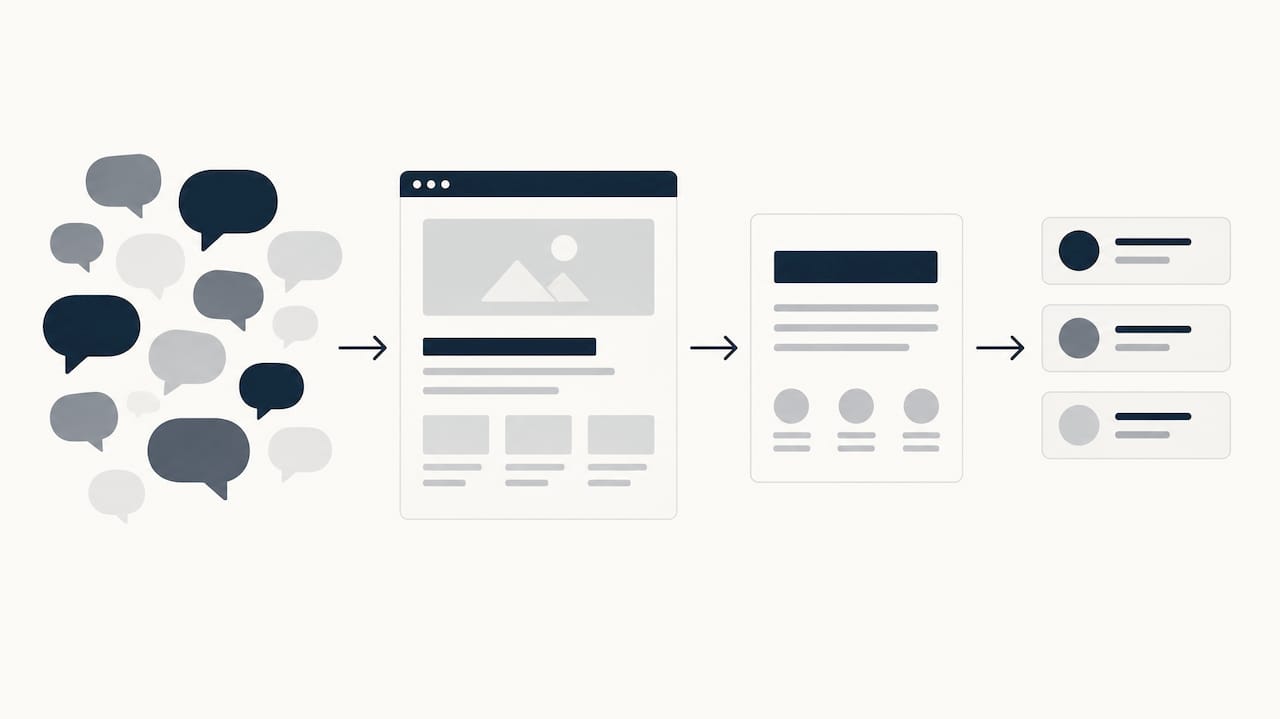
When the headline says plainly who you help and what changes for them, the wrong-fit visitor leaves faster and the right-fit visitor writes in sooner. You get fewer vague enquiries and fewer conversations that end at “just send me a price.” That is the pattern clearer messaging tends to produce, and it is why we start homepage work with decision friction rather than with design.
So write the voice down, assign an owner, and check it against every page before it ships. A voice that lives in a document nobody opens is no voice at all.
How can we help you get your voice onto the page?
If you would rather not draft this alone, we build a conversion-focused homepage blueprint for service businesses. It draws on voice-of-customer capture, a positioning session, and a video walkthrough, so your team gets a clear plan for headline, proof and calls to action that sounds like you. 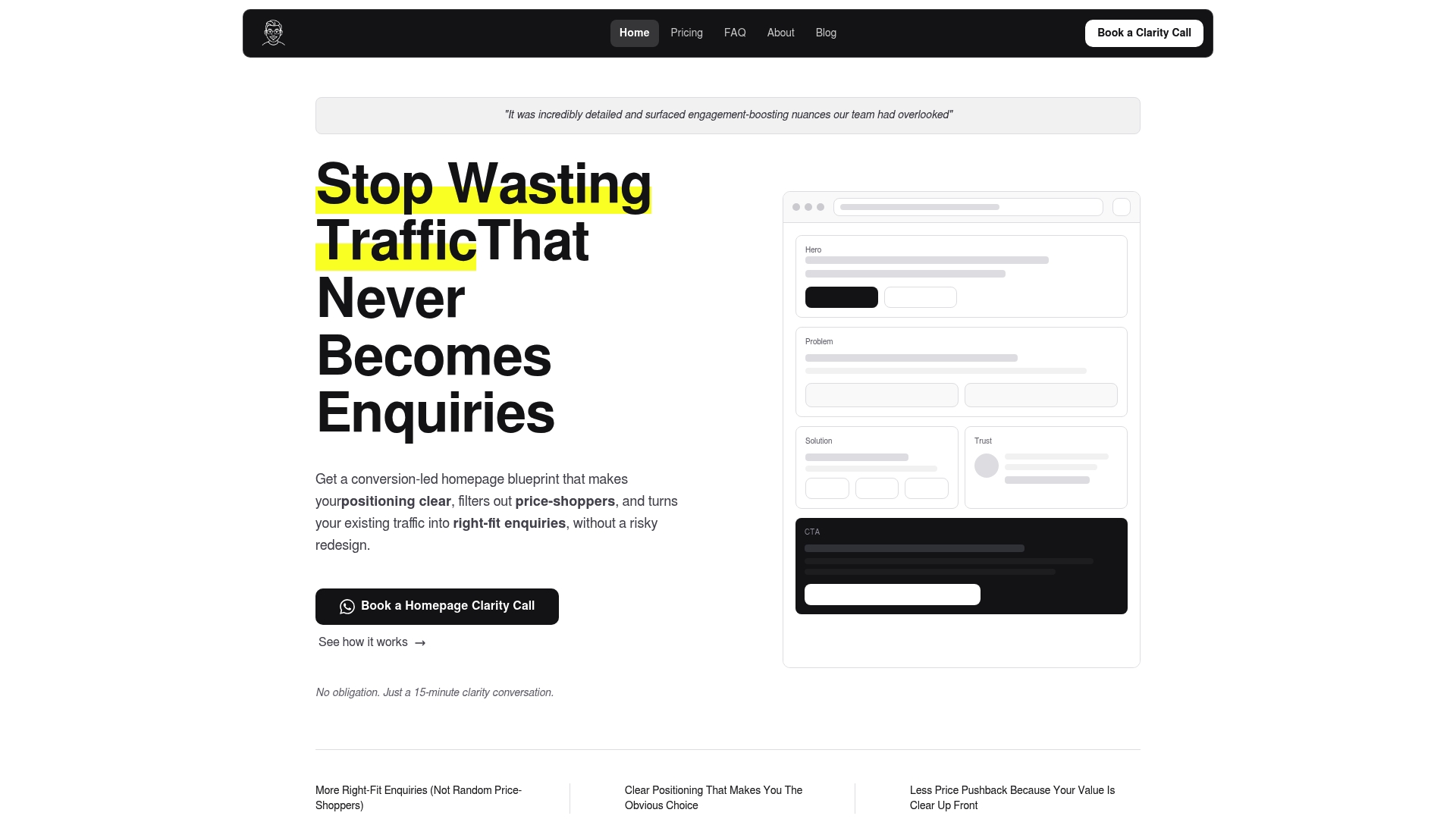
You can see what each deliverable includes on our pricing page, or start with our Free Website Review and we will tell you where your homepage language creates hesitation.
FAQ
What does voice mean in marketing?
Voice is the consistent personality a brand shows in its words, such as direct, warm or expert. It stays the same across channels, while tone shifts to suit the situation. Think of voice as who is speaking and tone as how they speak in that moment.
What are the four dimensions of tone?
The Nielsen Norman Group’s tone framework names formality, humor, respectfulness and enthusiasm. Rating each channel on those four lines helps you plan how your voice flexes without changing who you are.
What is the role of tone and voice in branding?
Together they shape how trustworthy and approachable a brand feels. The Nielsen Norman Group found that trust is a strong predictor of willingness to recommend, so voice choices can affect referrals as well as first impressions.
How many voice attributes should a service firm choose?
Three to five is enough for most teams. More than that becomes hard to remember and hard to apply consistently. Pair each with a “never” boundary so writers interpret it the same way.