Stop Losing Leads: Review Mining with LLMs for Service Businesses
Use LLM opinion unit pipelines to extract aspect level insights, link themes to ratings, and turn customer language into homepage copy.
Review mining is the practice of extracting structured insights, aspect level themes, sentiment patterns, and prioritized issues, from unstructured customer reviews using data mining and AI. Done well, it tells you which specific features or moments drive satisfaction or churn, not just whether people feel good or bad. Simple keyword counting can get you started, but modern pipelines built on aspect-based sentiment analysis and large language models get you much closer to insights you can act on.
TL;DR:
- Review mining that targets aspect-based sentiment analysis and large language models delivers the highest accuracy, especially for multi-aspect reviews, but at higher compute costs.
- Small samples of 50 to 100 reviews are sufficient for initial pattern detection, while larger, representative datasets are necessary for scale decisions.
- Manual hand-tagging of about 100 reviews helps validate automated tools and ensures more reliable insights before scaling.
- Choices between open-source tools, cloud APIs, or managed platforms depend on control preferences, budget, and desired speed of deployment.
Table of Contents
- 1. What review mining is and where it helps
- 2. Core methods, from lexicons to transformers
- 3. A pipeline you can actually run
- 4. Choosing your tools without locking yourself in
- 5. Evaluating quality and avoiding the common traps
- 6. A research-backed pattern worth copying
- 7. Why mined insights matter more once they hit your homepage
- 8. A discreet next step for turning insight into enquiries
- Sources
- FAQ
1. What review mining is and where it helps
Review mining sits alongside a few related terms you will see used almost interchangeably: opinion mining (extracting subjective statements), aspect-based sentiment analysis or ABSA (tying sentiment to specific product or service features), and opinion units (small, self-contained statements like “check-in was slow” that are easier to classify than a whole paragraph).
The practical uses fall into a handful of buckets:
- Product improvement: spotting recurring complaints about a specific feature before they show up in churn numbers.
- UX research: finding where customers get confused or frustrated during onboarding or checkout.
- Marketing messaging: pulling the exact phrases happy customers use, then testing them in headlines and ads.
- Support triage: flagging emerging issues (a shipping delay, a bug) faster than ticket volume alone would show.
- Reputation management: tracking sentiment shifts after a product change or a public incident.
For a quick exploratory read, 50 to 100 reviews is usually enough to surface the obvious patterns. Anything you plan to act on at scale, like feeding a regression model or making a pricing decision, needs a larger and more representative sample.
2. Core methods, from lexicons to transformers
The method you choose depends on how much nuance you need and how much you are willing to spend on compute and engineering time.
Lexicon-based approaches score words against a dictionary of positive and negative terms. They are fast, cheap, and easy to explain, but they miss sarcasm, negation, and anything context-dependent. Classical machine learning (Naive Bayes, SVM, logistic regression on bag-of-words or TF-IDF features) improves accuracy over lexicons and still runs cheaply, but it typically scores a whole review rather than individual features within it.
That matters because most reviews mix opinions. A single sentence might praise the food and criticize the wait staff in the same breath. This is where aspect-based sentiment analysis earns its place: instead of one sentiment score per review, ABSA ties sentiment to each aspect mentioned, so “slow service” and “great food” are captured as two separate, correctly scored signals.
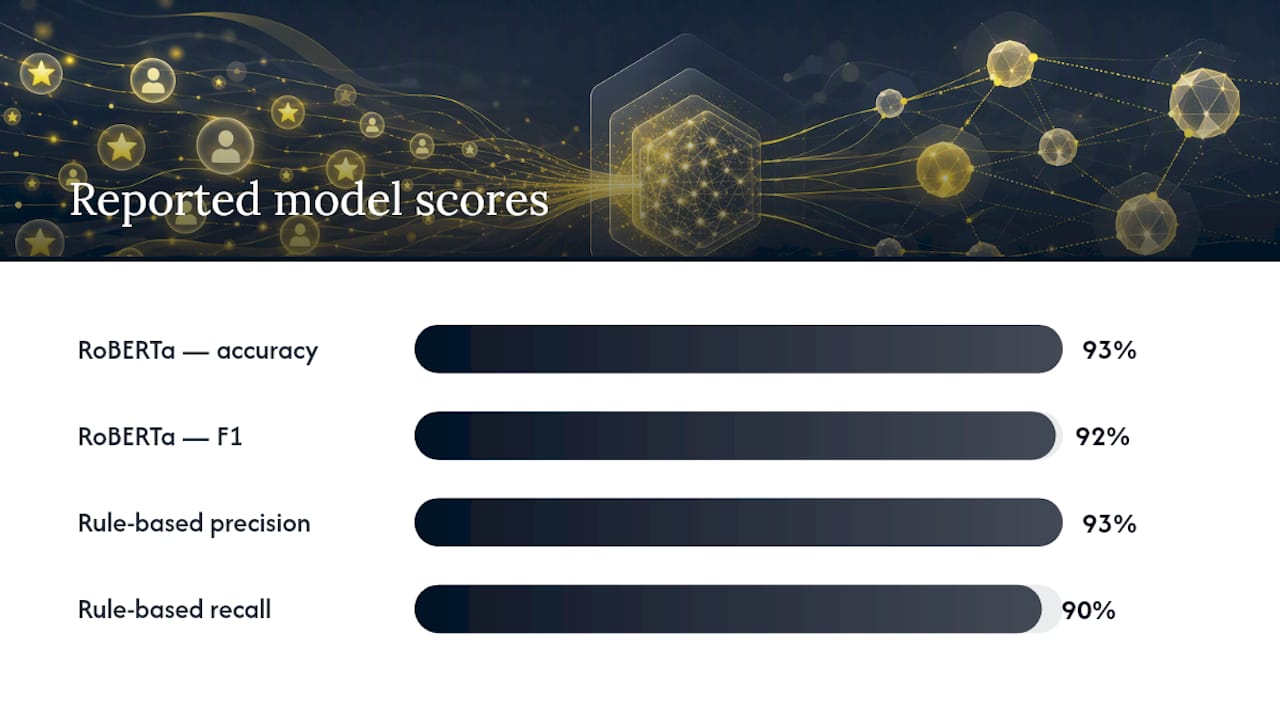
Transformer models push this further. Benchmarked ABSA studies show RoBERTa reaching roughly 93% accuracy and an F1 score near 0.92, well ahead of older LSTM and CNN baselines on the same tasks. Large language models go a step beyond classification: prompted correctly, they can extract clean opinion units directly from raw text, splitting compound sentences into the discrete statements that ABSA and topic models work best on.
- Lexicons: fast and interpretable, but blind to context and negation.
- Classical ML: solid accuracy at low cost, weak on multi-aspect nuance.
- ABSA: purpose-built for reviews that praise one thing and criticize another.
- Transformers and LLMs: the strongest aspect-level accuracy, at higher compute cost.
Rule-based heuristics still have a place. In cross-domain or low-resource settings, enhanced pattern-based extraction rules have reported precision of 0.93 and recall of 0.90 for pulling explicit product features out of review text, making them a reasonable complement or fallback when you cannot fine-tune a full model.
For most teams, the pragmatic path is a fine-tuned transformer for ABSA, with an LLM prompt layer for opinion-unit extraction where budget allows.
3. A pipeline you can actually run
You do not need a research lab to run a credible review-mining project. The steps are consistent regardless of scale.
- Collect your reviews. Pull from your review platforms, support tickets, or survey responses, and be deliberate about sampling so one loud segment of customers does not dominate the picture.
- Clean and deduplicate. Strip HTML, remove exact duplicates (common with copy-pasted reviews), and normalize spelling and casing.
- Split into sentences, then opinion units. A single sentence often contains two opinions. Breaking “the app is fast but the checkout kept freezing” into two separate statements, one about speed and one about checkout, keeps each opinion classifiable on its own terms.
- Run named entity recognition and dependency parsing to identify the product features, staff roles, or locations each opinion unit refers to.
- Cluster the opinion units using topic modeling, then read cluster prevalence as a rough proxy for how common each issue or praise point is.
- Link topics and sentiment to metrics. Regress the sentiment scores and topic flags against star ratings or conversion indicators to see which themes actually move the numbers.
Teams without a data science bench can still get value with a lightweight fallback: export reviews to a spreadsheet, tag a sample manually by aspect and sentiment, and use that tagged sample to spot-check any automated tool before trusting its output at scale.
Pro Tip: Before scaling any pipeline, hand-tag 100 reviews yourself. It takes an afternoon and gives you a ground truth to sanity-check every automated result that follows.
4. Choosing your tools without locking yourself in
Most teams land on one of three paths, and each trades convenience for control differently.
- Open-source libraries: spaCy for parsing and NER, the Hugging Face ecosystem for pretrained ABSA and sentiment models, and BERTopic-style workflows for clustering opinion units into topics. This path gives you the most control and the lowest recurring cost, at the price of engineering time.
- Cloud APIs and LLM prompts: sending review text to a hosted language model with a prompt designed to extract opinion units and sentiment. Fast to prototype, easy to iterate on, but usage-based pricing can add up at high review volumes.
- Managed analytics platforms: dashboards that handle collection, tagging, and reporting for you. They trade customization and raw data access for speed of setup, which suits teams that want insight without building a pipeline.
Deployment choices matter as much as model choice. Batch processing (running everything overnight or weekly) is cheaper and simpler than streaming, and it is the right default unless you need same-day alerts on emerging issues. If your customers write in more than one language, check any model’s multilingual support before committing, since accuracy often drops outside English and other high-resource languages.
5. Evaluating quality and avoiding the common traps
A review-mining pipeline is only as useful as its accuracy, and accuracy needs to be measured, not assumed.
- Precision, recall, and F1 for aspect extraction tell you whether the model is finding the right features and correctly labeling their sentiment.
- Coherence scores for topic models tell you whether each cluster actually represents one recognizable theme rather than a grab bag of unrelated opinions.
- R² for rating prediction tells you how well your extracted topics and sentiment actually explain the star ratings customers give.
Validation should include a human-in-the-loop step: have someone read a sample of the model’s outputs against the original text, and test the pipeline on a different product category or time period before trusting it broadly.
Watch for four recurring pitfalls: fake or incentivized reviews skewing sentiment, class imbalance (five-star reviews drowning out the handful of one-star reviews that carry the real signal), cultural or language bias in how sentiment is expressed, and models that overfit to one product line and fail on another. On the legal side, testimonial handling has real rules attached: guidance for Singapore explicitly prohibits fabricated or AI-generated testimonials and requires documented consent before a customer’s words are used in marketing.
Trust signals built on real reviews carry real weight. Star ratings and reviews are among the most persuasive elements in a buyer’s decision, which is exactly why fabricating or mishandling them is both a compliance risk and a wasted opportunity to use the real ones well.
6. A research-backed pattern worth copying
A pattern worth borrowing directly from recent research: extract opinion units with an LLM first, cluster them by topic, then regress sentiment and topic flags against a business metric like star rating. One 2025 paper testing exactly this sequence reported a rating-prediction R² of 0.726, a strong result for a task built purely from unstructured text.
The improvement over sentence-level clustering comes down to granularity: opinion units keep one idea per statement, so topic models produce sharper, more coherent clusters instead of muddled ones built from mixed-sentiment sentences. The paper also found that using sentiment-aware embeddings, or simply splitting units by sentiment before clustering, improves how cleanly each topic maps to a single sentiment direction.
| Step | What it does | Why it helps |
|---|---|---|
| Opinion-unit extraction | Splits compound sentences into single-idea statements | Raises topic coherence |
| Sentiment-aware clustering | Groups units by topic and sentiment together | Produces cleaner, single-direction topics |
| Metric regression | Predicts ratings from topic and sentiment flags | Reported R² = 0.726 |
This approach asks for more setup than a basic sentiment score, so it earns its cost when you have enough review volume to make clustering meaningful and a real business metric to regress against. Separate research on LLM-based opinion clustering also stresses that human judgment is still needed to turn a cluster into a strategic decision. No model tells you what to do about a theme, only that the theme exists.
7. Why mined insights matter more once they hit your homepage
The real payoff of review mining shows up when the language customers actually use starts replacing the language you assumed would land. A recurring phrase about “finally getting a straight answer” says more about your positioning than any internal brainstorm, and it belongs in your headline, not buried in a report.
Insights only earn their keep once someone rewrites a page with them.
— Fadly
8. A discreet next step for turning insight into enquiries
Mining your reviews will tell you what customers value and where they hesitate, but that insight only pays off once it reshapes the page they land on. This approach addresses issues like decision friction on a homepage, vague claims, missing proof, and buried calls to action by turning customer language and mined insights into a structured blueprint: what to say, where to place proof, and what the page should ask visitors to do next.
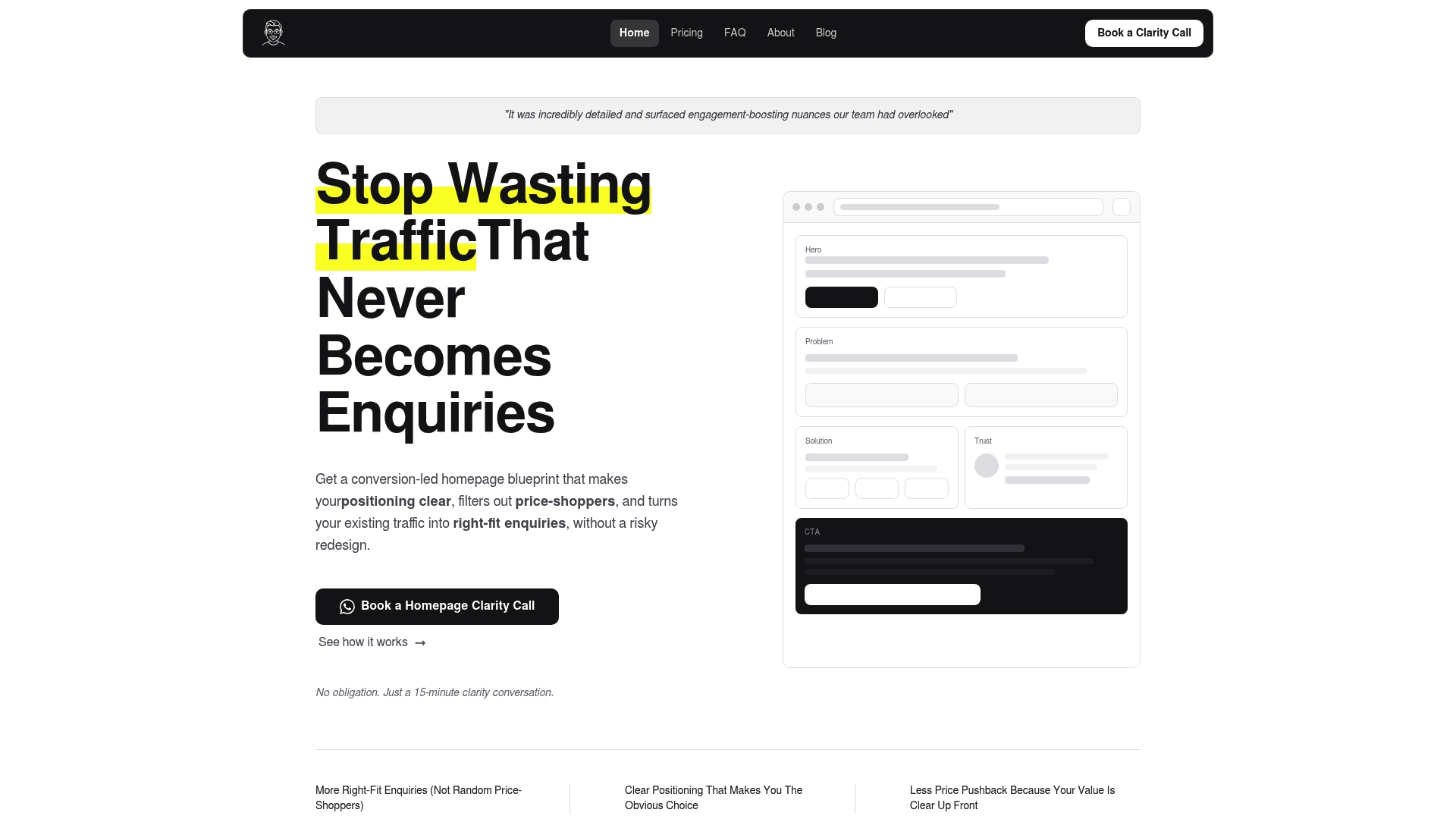
This fits service businesses that already get traffic but have challenges converting visitors into quality enquiries. It is not a redesign and not a guess, it is a plan built around what your own customers already told you works. If you want a first look at where your homepage is losing people, start with a free website review and see what a blueprint would target.
Sources
- TopicImpact: LLM opinion units + topic modeling to predict ratings (arXiv 2025)
- Aspect-based sentiment analysis with transformer-based models (2026 DOI summary)
- Enhanced heuristic pattern-based explicit feature extraction (PeerJ 2025)
FAQ
Do reviews get paid?
Some platforms and brands run incentivized review programs, but genuine organic reviews are not paid for by the business being reviewed. Where incentives exist, disclosure rules typically require the reviewer to state that clearly, and marketing guidance in Singapore explicitly bars fabricated testimonials from being used without consent.
What is opinion mining?
Opinion mining is the broader task of identifying subjective statements in text and classifying the sentiment they express. Review mining is opinion mining applied specifically to customer reviews, often narrowed further with aspect-based sentiment analysis to tie each opinion to a specific product or service feature.
What is review in simple words?
A review is a piece of writing where a customer shares their experience with a product or service, usually including some judgment about whether it was good or bad. In review mining, that text is treated as data: broken into smaller statements, tagged by topic and sentiment, and analyzed for patterns across many reviews at once.
How do I find my own reviews?
Check the review sections of the platforms where your business is listed, along with any survey or feedback tool you use directly with customers. For a first pass, reading through 50 to 100 recent reviews by hand is usually enough to spot the themes worth digging into further.
Recommended

About the author
Thiam Hock is the founder of Hockworks, a Singapore-based digital advisory focused on clarity-driven websites. He works with service businesses to design websites that guide decisions, filter the right enquiries and reduce hesitation. His perspective centres on positioning, differentiation and how visitors actually make decisions in competitive markets.
Read more about Thiam Hock →