Stop Bad Leads: Lead Qualification Questions, CRM Rules & Homepage
Turn inbound interest into right fit opportunities with a plug and play question bank, CRM rules, and homepage fixes that speed qualification and reduce...
Start with a short BAND-style first pass plus a six to eight question discovery script, then escalate high-potential leads into MEDDIC or MEDDPICC for deeper qualification. This two-tier approach disqualifies poor-fit leads within minutes instead of weeks, and it keeps your pipeline focused on prospects worth a proposal. The full question bank, scoring model, and CRM setup follow below.
TL;DR:
- Using a quick initial pass with BANT filters out low-potential leads in short sales cycles, freeing up time for more promising prospects.
- Longer, enterprise deals benefit from MEDDIC or MEDDPICC frameworks that uncover critical stakeholders, decision criteria, and procurement risks early.
- Clear, goal-oriented qualification questions should be tied to scoring models and mandatory CRM fields to ensure consistent, actionable insights during the sales process.
- Improving homepage messaging to clarify target audiences and investment levels ensures only better-fit inquiries reach the qualification stage.
- Regular data cleansing, SLA enforcement, and team alignment are essential to prevent qualification breakdowns caused by bad data, slow follow-ups, or miscommunication.
Table of Contents
- Ready-to-use lead qualification questions by purpose
- Choosing between BANT, MEDDIC, CHAMP, and other frameworks
- Turning your questions into a working qualification system
- Fixing the problems that quietly break lead qualification
- How clearer homepage messaging improves the leads that reach you
- A quick checklist to run this week
- Get better-fit enquiries before your team even asks a question
- Sources
- FAQ
Ready-to-use lead qualification questions by purpose
Before you hand your team a script, decide on tone. A form field should ask closed, specific questions because you’re filtering at scale. A discovery call should ask open questions because you’re trying to understand a real situation, not check a box. Mixing the two up is the most common mistake I see: forms that read like therapy sessions, and calls that sound like a compliance audit.
Buyers now do most of their homework before they ever talk to you. The 6sense Buyer Experience Report found that B2B buyers complete roughly 60% of their evaluation independently, and 94% of buying groups have already identified a preferred vendor before the first sales conversation. That means your questions aren’t just filtering, they’re often the first real signal you get about whether a prospect actually fits, so make them count.
Here’s a working set, grouped by what each one is meant to uncover.
Discovery and need
- What’s driving you to look for a solution now, rather than six months ago or six months from now?
- What have you already tried, and why didn’t it stick?
Budget and ROI
- What budget range have you set aside for solving this, if any?
- If this works the way you hope, what would that be worth to your business over the next year?
Authority and buying committee
- Who else needs to sign off before you can move forward?
- Has this project been through a similar approval process before, and how long did that take?
Timeline and urgency
- What’s driving your timeline, a deadline, a budget cycle, or something else?
- When would you want this fully in place?
Metrics and outcomes
- How are you measuring success on this right now, even informally?
- What would need to be true in 90 days for you to call this a win?
Technical and paper process
- Does your organization require a formal procurement or legal review for this kind of purchase?
- Are there security, compliance, or vendor-approval steps we should plan around?
Champion and competition
- Who inside your company is pushing hardest for this to happen?
- Who else are you evaluating, and what’s standing out about them so far?
On a form, “What budget range have you set aside?” becomes a dropdown with bands. On a call, the same question opens into “Walk me through how this typically gets funded,” which tells you far more about internal politics than a number ever could. A vague answer to the authority question (“I’ll loop in some people”) is itself a signal: the deal probably isn’t as advanced as the prospect thinks it is.
Pro Tip: Ask the timeline question before the budget question. Prospects with a real deadline tend to answer budget questions more honestly, because urgency forces a decision they’ve usually already half made.
Choosing between BANT, MEDDIC, CHAMP, and other frameworks
None of these frameworks is universally right, and picking one because it’s popular is how teams end up asking questions that don’t match their sales cycle. Each earns its place in a specific kind of deal.
BANT (Budget, Authority, Need, Timeline) is the fastest of the group and works well for short cycles and lower-complexity offers, where a quick yes or no on four dimensions is enough to decide whether a rep should invest time. Its speed is also its weakness: Salesforce’s comparison of BANT and MEDDIC notes that BANT can miss nuanced indicators, like a champion who lacks real influence or a paper process that will stall the deal for months.
MEDDIC (Metrics, Economic Buyer, Decision Criteria, Decision Process, Identify Pain, Champion) digs deeper into enterprise-style deals where multiple stakeholders and a formal decision process are involved. MEDDPICC adds Paper Process and Competition on top, which matters once legal review or procurement can single-handedly kill a deal that everyone else already agreed on. HubSpot’s rundown on MEDDPICC suggests making a few of these fields mandatory in your CRM, since that alone tends to surface missing stakeholders or paper-process blockers earlier than reps would catch them on their own.
CHAMP (Challenges, Authority, Money, Prioritization) leads with the prospect’s problem instead of their budget, which suits teams selling into organizations that don’t yet know they have a budget line for your category. GPCTBA/C&I (Goals, Plans, Challenges, Timeline, Budget, Authority, Negative Consequences, Positive Implications) and ANUM/FAINT (Authority, Need, Urgency, Money, or Funds, Authority, Interest, Need, Timing) push further into consequence-based selling, useful when you need the prospect to feel the cost of inaction before they’ll commit. HubSpot’s guide to sales qualification points out that open-ended, goal-focused questions across any of these frameworks tend to produce richer answers than a blunt “what’s your budget?”
A practical way to decide which to run:
- Deal size under a few thousand dollars, short cycle: BANT is usually enough.
- Multiple stakeholders, formal procurement, six-figure deals: MEDDIC or MEDDPICC.
- Category-naive buyers who don’t know they have this problem yet: CHAMP.
- Long consideration cycles where you need to build urgency: GPCTBA/C&I.
Most teams do best with a hybrid: BANT as the fast first filter on every inbound lead, then MEDDIC or MEDDPICC layered in once a lead clears that bar and enters a real sales cycle.
Turning your questions into a working qualification system
Questions only change outcomes when they’re tied to a scoring model, CRM fields, and rules about what happens next. Here’s how to build that.
- Score fit and readiness separately. Fit measures whether the prospect matches your ideal customer profile (industry, company size, use case). Readiness measures whether they’re likely to buy soon (budget confirmed, timeline set, pain acknowledged). A high-fit, low-readiness lead needs nurturing, not a sales call.
- Set point values and thresholds. Give each answer a rough weight, for example 10 points for a confirmed budget, 5 for a named timeline, 0 for “just researching.” Salesforce’s Trailhead module on lead qualification frames this as the difference between an MQL, a lead who matches your profile and shows interest, and an SQL, a lead your sales team has verified as ready to talk seriously.
- Add required CRM fields before a stage move. Fields like economic buyer, decision timeline, identified pain, and paper process status should be mandatory before a deal can move from discovery to proposal. This forces reps to actually ask the questions instead of skipping ahead.
- Write an SLA for the marketing-to-sales handoff. Define time-to-first-contact (five minutes beats five hours for inbound leads), a follow-up cadence if the prospect doesn’t respond, and who owns the lead at each stage.
- Automate what you can. Lead enrichment tools like those from benchmarked can pre-fill firmographic data before a rep ever picks up the phone, and routing rules can send high-score leads straight to your best closers while low-score leads go to nurture sequences.
Pro Tip: Set a mandatory timeout rule: if a lead hasn’t been contacted within your SLA window, it automatically escalates to a manager. This one rule fixes more lost-lead problems than any script change.
Track a small set of metrics to know if any of this is working: MQL-to-SQL conversion rate, average contact speed, and a simple tally of disqualification reasons. That last one is easy to skip and it’s the most useful, since it tells you whether your questions are catching the right things or just generating paperwork.
Fixing the problems that quietly break lead qualification
Even a good question set fails if the process around it is broken. Three problems show up again and again.
Bad data. Duplicate records, missing fields, and stale contact information make it impossible to trust your scoring model. Spot it by running a monthly report on how many leads are missing a required field. Fix it with mandatory form fields at capture, a recurring weekly data cleanse, and validation rules that reject obviously fake entries (no one works at a company called “asdf”).

Team misalignment. Marketing calls a lead qualified; sales calls the same lead a waste of time. You’ll see this in a high MQL count paired with a low MQL-to-SQL conversion rate. Fix it with a shared SLA dashboard both teams can see, a joint definition of what counts as sales-ready, and a monthly review of disqualified leads to recalibrate.
Slow follow-ups. A lead that waited three days for a callback has usually already talked to someone else, especially given how much evaluation happens before first contact. Spot it in your average response-time report. Fix it with automated routing the moment a lead crosses your qualification threshold, and a manager escalation if no one responds in time.
A one-week checklist to apply this:
- Audit your CRM for the top three missing or inconsistent fields.
- Confirm your SLA is written down and visible to both teams.
- Pull last month’s disqualified leads and check whether your current questions would have caught them sooner.
How clearer homepage messaging improves the leads that reach you
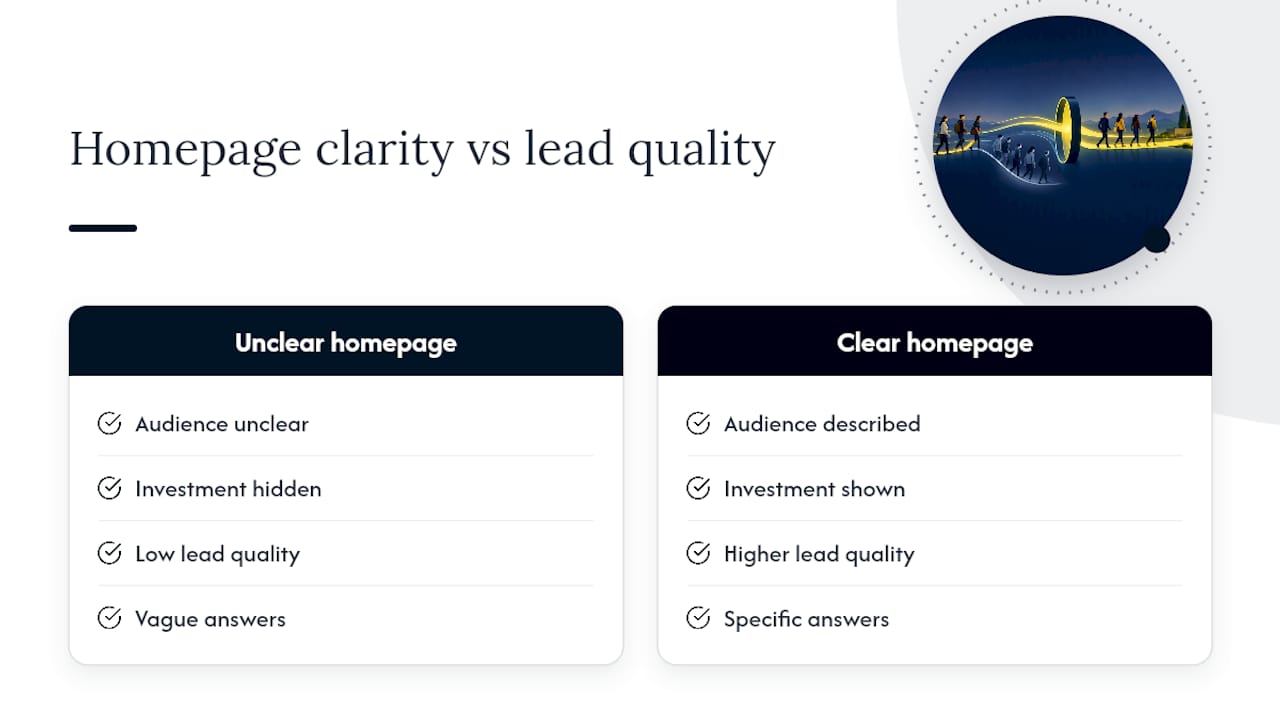
A lot of unqualified inquiries never should have reached your inbox in the first place. When a homepage doesn’t clearly state who a service is for and at what investment level, it invites the wrong prospects to fill out the form, which pushes the qualification burden onto your sales team.
Some companies build homepage blueprints that clarify positioning and premium value before a visitor ever reaches your contact form, alongside a post-contact roadmap that sets clear next steps once they do. Sharper messaging upfront means the people who do reach out already know roughly what they’re buying and what it costs, which shows up as better, more specific answers to your qualification questions from the very first touch.
A quick checklist to run this week
Three checks before Friday: confirm your CRM requires economic buyer, timeline, and paper-process fields before a stage move; confirm your SLA for time-to-first-contact is actually enforced, not just written down; and make sure your discovery script includes the five questions that matter most, need, budget, authority, timeline, and decision process. Measure impact over 30 days by comparing MQL-to-SQL conversion before and after.
— Fadly
Get better-fit enquiries before your team even asks a question
Good qualification questions help you sort the leads you already have. A clearer homepage changes who shows up in the first place. Hockworks builds conversion-focused homepage blueprints that clarify your positioning and premium value, so the enquiries hitting your form are already closer to sales-ready, which means your discovery calls spend less time on basic fit and more time on closing.
If you’re not sure whether your current homepage is the problem, start with a Free Website Review to see where visitors are hesitating before they ever reach your qualification questions.
Sources
- 6sense Buyer Experience Report 2025
- Inside the MEDDPICC methodology — insights from the sales pros who use it | HubSpot
FAQ
What is the 3-3-3 rule in sales?
The 3-3-3 rule isn’t a standard part of the qualification frameworks covered in this guide, and definitions of it vary across sales teams. Rather than relying on an unverified rule, focus on the tested frameworks here, BANT, MEDDIC, MEDDPICC, CHAMP, GPCTBA/C&I, or ANUM/FAINT, which have clear, documented question sets.
What are some qualifying questions?
Strong qualifying questions cover need, budget, authority, timeline, and decision process, such as “What’s driving you to solve this now?” or “Who else needs to sign off before you can move forward?” Open-ended questions tend to surface richer answers than closed yes or no prompts, according to HubSpot’s sales qualification guide.
What are lead qualifications?
Lead qualification is the process of determining whether a prospect matches your ideal customer profile and is likely ready to buy. Teams typically split this into an MQL, a lead who fits the profile and shows interest, and an SQL, a lead sales has verified as ready for a real conversation, a distinction outlined in Salesforce’s Trailhead lead qualification module.
How do you go about qualifying a lead?
Start with a short first pass using a fast framework like BANT to catch obvious mismatches, then escalate promising leads into a deeper framework like MEDDIC or MEDDPICC for complex deals. Pair this with mandatory CRM fields and a clear marketing-to-sales SLA so the questions actually change what happens next, not just what gets recorded.
Recommended

About the author
Thiam Hock is the founder of Hockworks, a Singapore-based digital advisory focused on clarity-driven websites. He works with service businesses to design websites that guide decisions, filter the right enquiries and reduce hesitation. His perspective centres on positioning, differentiation and how visitors actually make decisions in competitive markets.
Read more about Thiam Hock →