Double Conversions with Customer-Centric Copy for Service Businesses
Use a 2–3 hour Voice of Customer process, 5th–7th grade readability rules, and homepage templates to rewrite customer centric copy and boost conversions...
Customer-centric copy is writing that leads with the customer’s own words, goals, and decision path instead of the company’s features or internal jargon. The immediate payoff is clearer messaging that reduces confusion, keeps visitors reading, and lifts engagement and conversions. The fastest way to start is simple: pull language straight from your customers and write to them in second person, not about yourself in third.
TL;DR:
- Writing at a fifth to seventh grade reading level can double conversion rates compared to more complex, polished language.
- Using customer language mined from reviews and support interactions in headlines and calls-to-action significantly improves relevance and response.
- Focus on the top-desired outcomes and common objections when rewriting homepage headlines, CTAs, and qualifiers for better engagement.
- Testing copy changes through tracking click-through, micro-conversions, and qualitative feedback is essential to measure real performance improvements.
- Most successful businesses treat voice-of-customer research as a mandatory step, not optional, before writing or rewriting key messaging elements.
Table of Contents
- What Makes Copy Customer-Centric (And Why It Matters)
- The Core Rules That Make Copy Convert
- How to Find the Words Your Customers Actually Use
- A Checklist and Templates for Rewriting Your Homepage
- How to Test Whether Your New Copy Actually Works
- How Hockworks Applies Voice-of-Customer Copy to Homepages
- Common Mistakes That Undo Customer-Centric Copy
- What Customer-Centric Copy Looks Like When It Works
- Writing Customer-Centric Copy Across Channels and Formats
- The Gap Between Knowing This and Doing It
- Get a Free Website Review or a Homepage Blueprint
- Sources
- FAQ
What Makes Copy Customer-Centric (And Why It Matters)
You’ve probably heard “write for your audience” a hundred times. Here’s what that actually means in numbers: pages written at a 5th to 7th grade reading level convert roughly twice as well as professional corporate writing and significantly better than 8th to 9th grade copy, according to Unbounce’s 2024 conversion benchmark report. That’s not a small gap. It’s more than double the conversion rate, and the only variable is how simply you write.
Statistic Callout: Landing pages written at a 5th to 7th grade reading level convert at considerably higher rates than pages written in polished, professional language, per Unbounce’s 2024 data.
Why does simpler language win? Because every unfamiliar word or vague phrase creates decision friction, a small mental tax the visitor pays before deciding whether to trust you. The Nielsen Norman Group found that writing which is concise, scannable, and objective improved usability by 124% in combined testing. That’s not a minor polish. Objective, plain-language copy removes the friction that makes visitors bounce before they even reach your call to action.
If you’re wondering where to spend your effort first, prioritize the sections that do the heavy lifting: your homepage hero, your calls-to-action, product or service pages, and anywhere a visitor decides whether to keep going or leave. A vague hero headline costs you more than a slightly weak paragraph three scrolls down. Fix the top of the page first.
The Core Rules That Make Copy Convert
Good customer-centric copy follows a small set of rules you can apply today, without a full rewrite. None of these require a design team or a new brand voice. They just require you to stop writing about your company and start writing to your visitor.
- Write headlines in second person (“you get,” “your team saves”) instead of third person (“our clients receive”).
- Lead with the outcome or benefit, then explain the feature that delivers it, not the other way around.
- Cut jargon and internal terminology; if a new employee wouldn’t understand it, a visitor won’t either.
- Make buttons and labels specific (“See Your Homepage Plan” beats “Submit”).
- Add a self-qualifying line like “This is for you if…” so the right visitors recognize themselves fast.
Here’s a quick before and after. Weak: “We provide comprehensive website solutions for businesses.” Strong: “You’ll get a homepage that turns more visitors into enquiries, without a full redesign.” The second version tells the visitor exactly what changes for them.
Pro Tip: Read your headline out loud. If it sounds like something from an annual report, rewrite it as something you’d actually say to a client sitting across from you.
How to Find the Words Your Customers Actually Use
Guessing at customer language is the single most common way copy projects go sideways. The fix is a Voice of Customer, or VoC, process: mining what customers actually say and using their own words as your first draft. According to Brevvi’s VoC guide, copy built from real customer language has outperformed copywriter-invented language by wide margins in documented case examples, sometimes by nearly double.
A workable VoC process takes a few hours, not a few weeks. Here’s the sequence:
- Mine the raw material. Pull language from customer reviews, support transcripts, sales call notes, forum threads, and the exact phrases people type into search.
- Sort into five buckets. Tag each quote as a pain point, a desired outcome, an objection, a piece of proof, or an emotional statement.
- Count frequency and intensity. The phrase that shows up ten times, or the one said with the most emotional weight, tells you what actually matters. This is where opinion gets replaced by evidence.
- Map findings to page slots. The top desire becomes your headline. The top objection becomes an FAQ or a proof point near your CTA. The most common phrase for the outcome becomes your subhead.
- Time-box it. Give yourself two to three hours for a first pass. A rough VoC pass beats a perfect one you never finish.
Statistic Callout: Case examples in Brevvi’s research show customer-language copy delivering lifts of nearly double over copywriter-language variants, a gap wide enough to justify the two hours of mining.
The insight worth remembering: frequency and intensity, not your favorite phrase, should decide what goes in the headline.
A Checklist and Templates for Rewriting Your Homepage
Once you’ve mined your VoC data, the rewrite itself moves fast if you work from templates instead of a blank page. Start by ranking your findings: the pain point or desire mentioned most often, and with the most emotional charge, becomes your lead message. Everything else supports it.
Three fragments cover most of what a homepage needs:
- Headline: state the top desire in the customer’s own words. “Get more right-fit enquiries without a redesign” beats “Innovative website solutions.”
- CTA: pair a clear outcome with a clear action. “See Your Homepage Plan” tells the visitor what happens when they click; “Submit” doesn’t.
- Qualifier: one line that helps the right visitor self-select. “This is for you if you already get traffic but the enquiries aren’t converting” does more work than a paragraph of positioning.
Readability and formatting matter as much as the words themselves. Aim for a reading level in the same range Unbounce’s top-converting pages hit, and check every page on a phone screen before you call it done, since most visitors will read it there first.
| Page element | Customer-centric approach | Common mistake |
|---|---|---|
| Headline | Leads with the customer’s top desire | Leads with company name or mission |
| CTA button | States the outcome (“See Your Plan”) | Generic verb (“Submit,” “Learn More”) |
| Subhead | Clarifies who it’s for | Restates the headline in different words |
| Body copy | Short paragraphs, plain words | Dense paragraphs, internal jargon |
This is also where a tool like a behavioral data platform can help larger teams spot which segments respond to which message, once you have enough traffic to test at scale.
How to Test Whether Your New Copy Actually Works
Rewriting copy is only half the job. You need to know if it’s working, and that means tracking the right numbers before and after the change.
- Watch click-through rate and conversion rate first. These tell you whether visitors are engaging with your new headline and CTA, and whether that engagement turns into enquiries or sales.
- Track micro-conversions too. Scroll depth, time to first click, and FAQ expansions often move before your main conversion metric does, giving you an early read.
- Run a basic A/B test when you have enough traffic. Split visitors evenly between old and new copy, and don’t call a winner until you have enough conversions on each side to trust the difference, not just a few days of data.
- Follow up with qualitative methods. Session replay tools, one-question micro-surveys, and five-minute user interviews explain why a version won, which a conversion number alone never will.
If your traffic is too low for a reliable A/B test, qualitative feedback and direct observation of where visitors hesitate will tell you more than a test with too few data points to trust.
How Hockworks Applies Voice-of-Customer Copy to Homepages
Hockworks diagnoses homepage decision friction by comparing what a business says about itself to what its actual customers say in reviews, sales calls, and support conversations. That gap is usually where enquiries drop off.
The businesses that struggle most aren’t unclear because they lack good clients. They’re unclear because their homepage still talks about services the way the founder pitches them in a sales call, not the way a stressed prospect searches for them at 11 p.m.
Mapping that customer language onto a homepage blueprint, rather than guessing at new headlines, tends to be worth the investment for service businesses already getting decent traffic but attracting the wrong-fit enquiries.
Common Mistakes That Undo Customer-Centric Copy
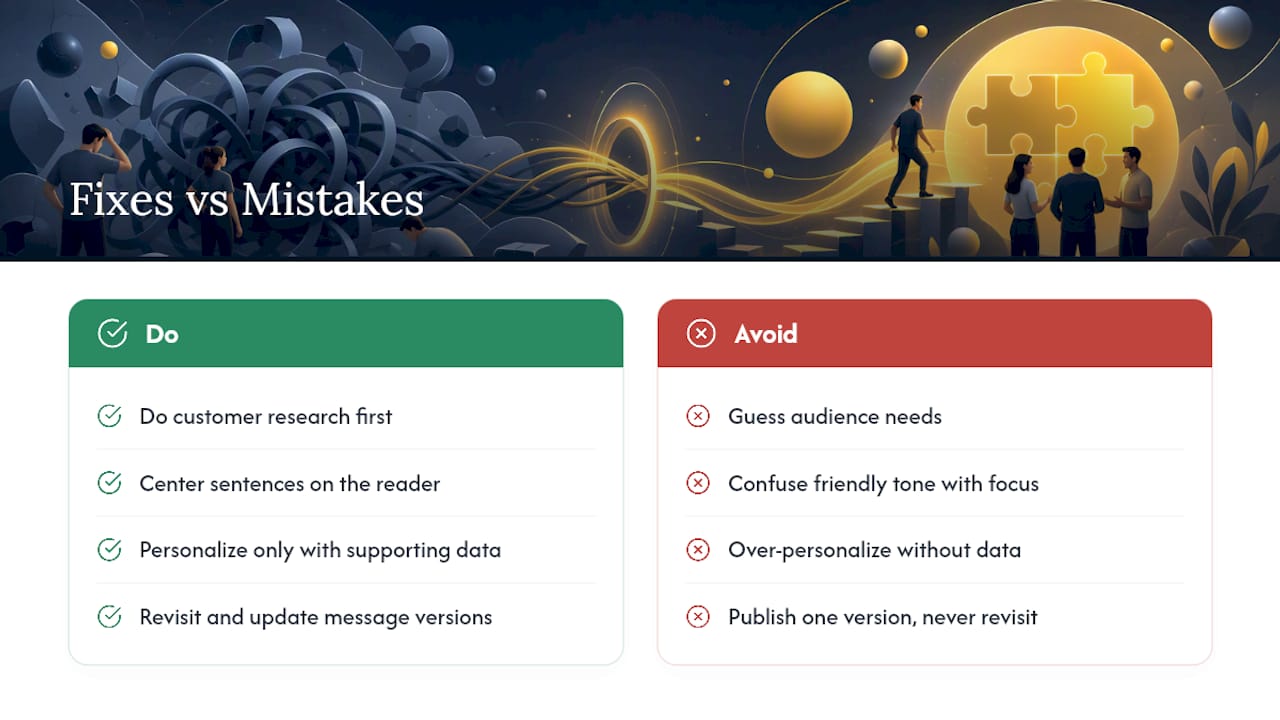
The biggest mistake is writing customer-centric copy without doing any customer research first. Guessing at what your audience wants to hear and calling it “customer-centric” defeats the purpose. If you haven’t read actual reviews or support tickets in the last month, you’re likely projecting your own assumptions.
The second mistake is confusing friendly tone with customer focus. Adding “we’re excited to help you” doesn’t make copy customer-centric if the next three sentences are still about your company’s history, awards, or process. Customer-centric means the sentence structure itself centers the reader, not that the mood is warm.
A third common error: over-personalizing without the data to back it up. Slapping a first name into an email subject line isn’t personalization if the offer underneath doesn’t match what that person actually needs. Research from Deloitte and Medallia frames personalization as a value exchange, something the customer should feel benefits them, not a tactic that just feels invasive.
Fourth, teams often write one version of their message and never revisit it. Customer language shifts as your market matures, and a headline that converted well two years ago can quietly go stale. Fifth, and often the costliest: burying the qualifier. If you don’t tell visitors who your service is for, unqualified visitors waste your team’s time and qualified ones assume you don’t serve them. A one-line “this is for you if” fixes both problems at once.
What Customer-Centric Copy Looks Like When It Works
The clearest examples of customer-centric copy share one trait: they replace a vague internal phrase with the exact words a customer used to describe their problem. A product page that says “improve operational efficiency” tells the visitor nothing. A product page that says “stop losing three hours a week to manual scheduling” is specific enough to feel like it was written for them, because it was.
Case research on product detail pages backs this up directly. Reordering page content to match the order shoppers actually prioritize information, rather than the order a company wants to present it, increased conversion by 15% to 35% or more in documented examples. The lift didn’t come from new information. It came from rearranging existing content around what customers actually search for and read first.
The same principle holds for smaller copy decisions. A support page rewritten around the exact phrasing customers use when they file a ticket, instead of the department’s internal terminology, tends to resolve confusion faster and gets marked as helpful more often. None of these examples required a redesign. They required listening to language that was already sitting in reviews, transcripts, and search queries, then putting it back on the page in the right order.
Writing Customer-Centric Copy Across Channels and Formats
The core principles hold everywhere, but the execution shifts by channel. A homepage has room for a qualifier line and supporting proof; a paid ad headline has about six words to earn a click, so it needs the single sharpest customer phrase you found in your research, with nothing else competing for attention.
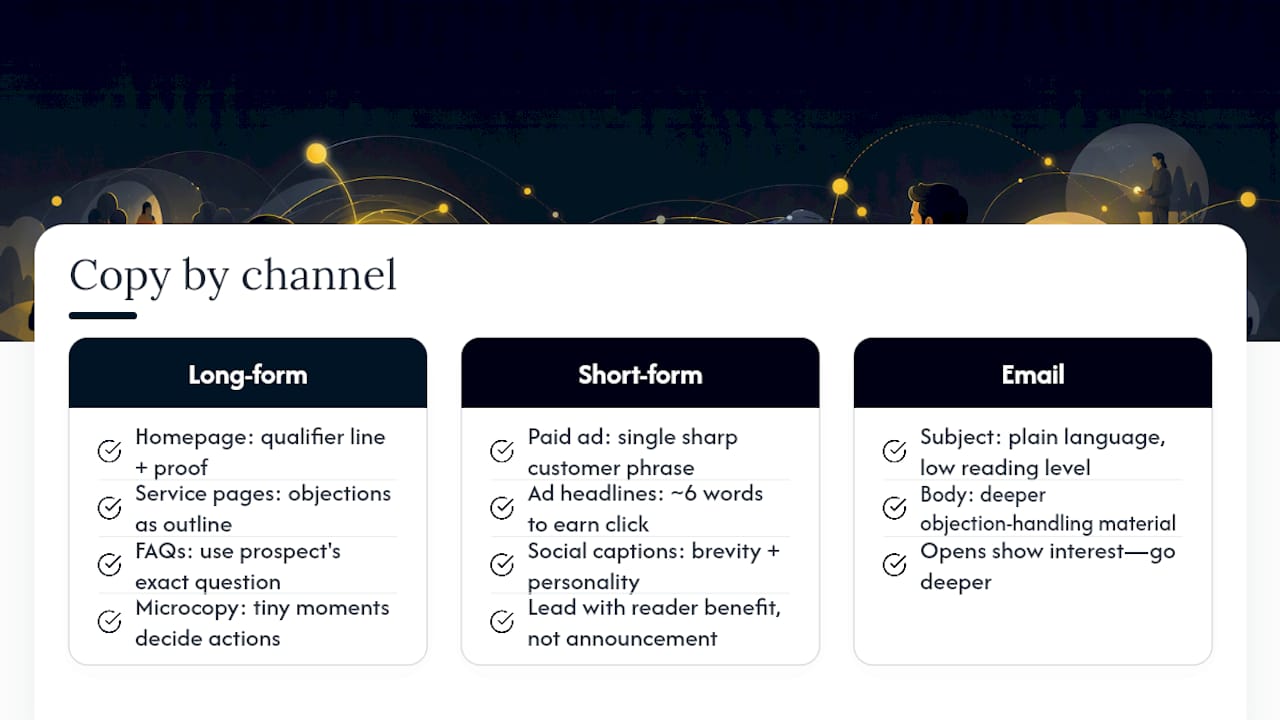
Email works differently again. Subject lines benefit from the same plain-language, low-reading-level approach Unbounce’s data supports, but the body can go deeper into the objection-handling material your VoC research surfaced, since a reader who opened the email has already shown interest.
Social captions need brevity and personality, but the underlying discipline doesn’t change: lead with what the reader gets, not what you’re announcing. A LinkedIn post that opens with “We’re thrilled to announce…” loses the reader before the actual value shows up. One that opens with the outcome a client experienced keeps them reading.
For service pages and FAQs specifically, the objections you gathered during VoC research become your outline. Each FAQ question should be the actual question a prospect asks, in their words, not a marketing-friendly rephrasing of it. Microcopy, the small text on buttons, form labels, and confirmation messages, deserves the same attention across every channel, since these tiny moments often decide whether someone completes an action or abandons it.
The Gap Between Knowing This and Doing It
Most of what’s in this article isn’t new information to experienced marketers. The Unbounce and NN/g findings have been circulating for a while, and “write for your customer” is advice nobody disagrees with in theory. The gap isn’t knowledge. It’s process.
Teams that struggle with customer-centric copy usually skip the VoC step entirely and jump straight to writing, relying on internal opinion about what sounds compelling. That’s backward. The businesses seeing real lifts are the ones treating VoC as a required input, not an optional nice-to-have, and using frequency and intensity to settle debates about which message goes first, rather than whoever argues loudest in the meeting.
The other overrated idea is that customer-centric copy requires a personality overhaul, warmer tone, more exclamation points, forced friendliness. It doesn’t. Plain, direct, confident language usually reads as more premium than hype does, particularly for service businesses selling to careful buyers. If you take one thing from this article, prioritize the two to three hours of VoC mining before you touch your homepage headline. Everything else compounds from there.
— Fadly
Get a Free Website Review or a Homepage Blueprint
Hockworks exists for the exact gap this article covers: businesses that already get traffic but aren’t converting enough of it into right-fit enquiries. Instead of a full redesign, Hockworks builds a structured homepage blueprint that maps your customers’ actual language onto your messaging, proof placement, and calls-to-action.
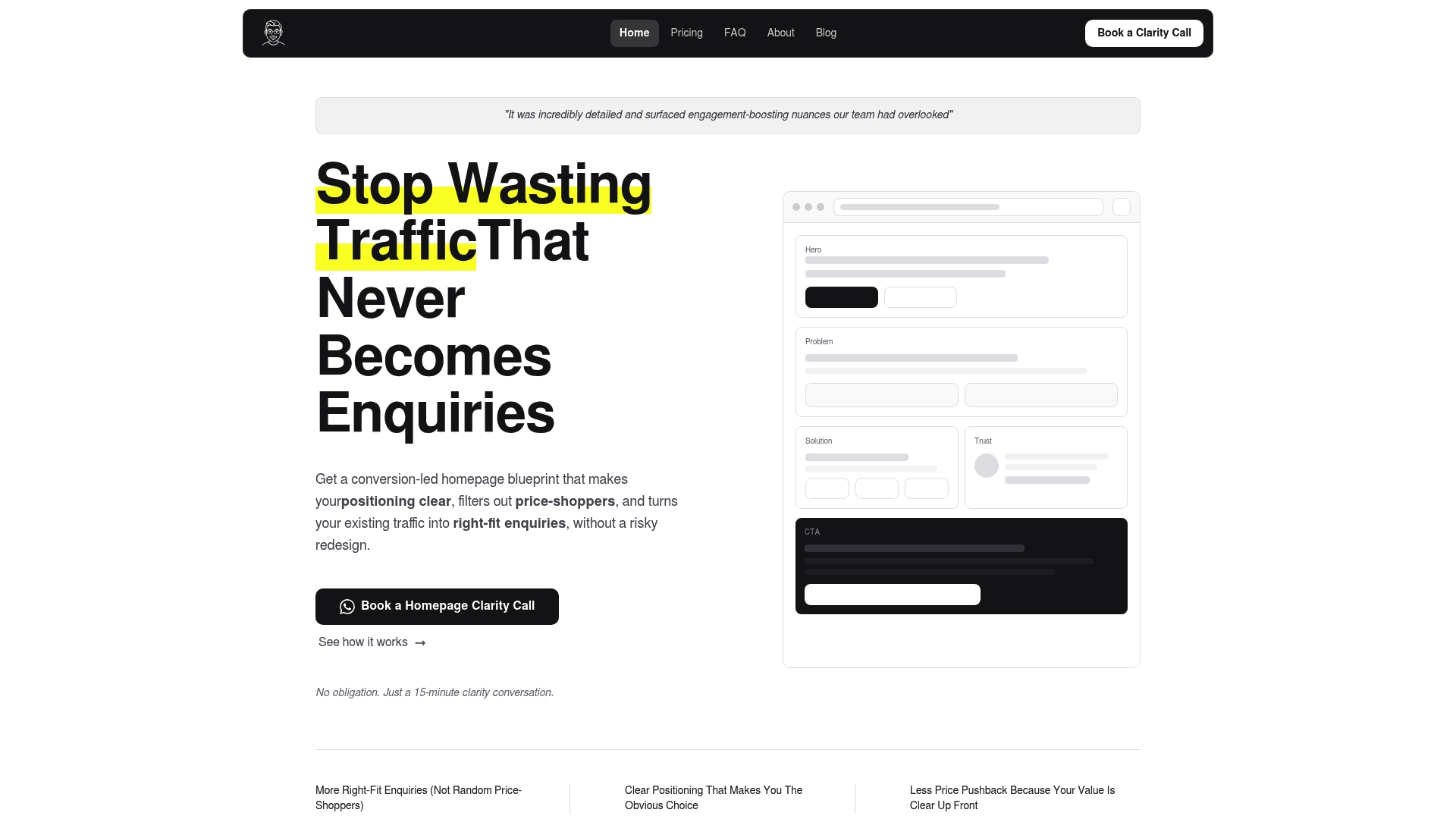
If you want a no-cost starting point, the Free Website Review looks at where your current homepage is losing visitors before you spend a dollar. If you’re ready to go further, the Homepage blueprint is a one-off engagement that delivers a full messaging plan and video walkthrough your team can implement without hiring a designer. It’s built for owners and marketing leads who already have traffic and know something in the message is off, not startups still testing whether their offer works. Start with the free review, then decide if the blueprint is the right next step for your homepage.
Sources
- Unbounce’s 2024 Conversion Benchmark Report Proves that Attention Spans are Declining, and so are Conversion Rates
- Concise, scannable, and objective: How to write for the web
- Voice of Customer Research: The Complete Guide for Copywriters | Brevvi
- Personalization: It’s a value exchange between brands and customers
FAQ
What does customer-centric mean?
Customer-centric means putting the customer’s needs, language, and decision process at the center of a business decision, rather than starting from internal preferences or product features. In copywriting specifically, it means writing to the reader in their own words instead of describing your company in yours.
What is another way of saying customer-centric?
Common alternatives include customer-focused, client-oriented, audience-centric, or user-driven copywriting. Marketers also describe this as writing “in the customer’s voice,” which reflects the same idea: using voice-of-customer research instead of internal assumptions.
What are the four C’s of customer centricity?
Definitions vary across sources, but a common version includes customer understanding, culture, capability, and communication, the idea being that a company needs internal alignment on all four before customer-centric messaging can stick. Treat this as a general framework rather than a fixed standard.
Can you give me an example of customer centricity?
A homepage that replaces “we provide comprehensive solutions” with a specific outcome a real customer described, like saving three hours a week, is customer-centric copy in action. Hockworks applies this by mining customer language before drafting a single headline for a homepage blueprint.
How much does a customer-centric homepage rewrite cost?
Pricing depends on scope. Hockworks lists a standalone Homepage blueprint at 480 SGD, a Homepage plus About page package at 680 SGD, and a full site blueprint at 2000 SGD, all one-off fees.
Recommended

About the author
Thiam Hock is the founder of Hockworks, a Singapore-based digital advisory focused on clarity-driven websites. He works with service businesses to design websites that guide decisions, filter the right enquiries and reduce hesitation. His perspective centres on positioning, differentiation and how visitors actually make decisions in competitive markets.
Read more about Thiam Hock →