Map Feedback to Homepage Wins: Voice of Customer Research for Leaders
Leader's VoC playbook: run a 30 day sprint, prioritize themes, close the loop, and use customer language to boost retention and homepage conversion.
Voice of customer research is the structured capture and analysis of customers’ own words across channels, built to produce prioritized, evidence backed actions that improve retention, messaging, and product decisions. It is not a survey you run once a year. Done right, it becomes a repeatable engine, and this guide walks through the methods, the setup, the measurement, and a practical example of how VoC language can reshape something as concrete as your homepage.
TL;DR:
- Voice of customer research requires ongoing collection and analysis from multiple channels, with a focus on themes and verbatim quotes tied to decision owners.
- Implementing a structured program with clear ownership, continuous data collection, and feedback closing boosts retention, reduces support costs, and improves messaging.
- Use automated NLP tools complemented by human review for scalable theme extraction, trend detection, and structured dashboards that link feedback to outcomes.
- Prioritize quick wins by testing customer language directly on homepage headlines and value propositions to reduce friction and increase conversions.
- Segment feedback by customer type and behavior to tailor messaging and identify issues most critical to high-value segments, maximizing impact.
Table of Contents
- What is voice of customer research?
- Why VoC matters: measurable benefits leaders should expect
- Core methods and data sources for VoC research
- A practical step-by-step VoC program (collection to closing the loop)
- Design: sample size, question design, and combining qualitative and quantitative methods
- Analyzing VoC data at scale: thematic coding, sentiment, and dashboards
- Measuring VoC program ROI and the closed-loop metrics that matter
- Common pitfalls, governance fixes, and red flags
- Applying VoC to homepage messaging and conversion
- Integrating VoC insights into product development and marketing strategies
- VoC platforms and tools overview (technology landscape)
- Ethical considerations and data privacy in VoC research
- Continuous vs. one-time VoC programs
- Segmentation and personalization in VoC data analysis
- Author perspective and realistic next steps for leaders
- How Hockworks helps: homepage blueprints informed by VoC
- Sources
- FAQ
What is voice of customer research?
Voice of customer research means systematically collecting what customers say, in their own words, across every channel where they interact with your business, then organizing that language into themes you can act on. It is broader than a single survey and deeper than analytics alone.
A single NPS survey tells you a score moved. It does not tell you why. Behavior analytics shows you where people dropped off on a page, but not what they expected to find there. VoC research sits between those two limits: it captures sentiment and reasoning in the customer’s own voice, then connects it to outcomes you can measure.
A properly run VoC program typically produces:
- Recurring themes, ranked by frequency and business impact
- Verbatim quotes that preserve the customer’s exact phrasing
- A prioritized list of issues or opportunities, tied to a decision owner
The distinction matters because a theme without an owner, or a quote without a priority, tends to sit in a spreadsheet and never influence a decision.
Why VoC matters: measurable benefits leaders should expect
The business case for VoC research rests on three outcomes: fewer customers leaving, lower support cost, and sharper messaging that converts more of the right prospects.
Retention is usually the fastest payoff. When you catch a recurring complaint early and fix the root cause, you stop losing customers for a reason that was fixable all along. Cost avoidance follows close behind: a theme that explains why a support queue keeps filling up often points to one process fix that prevents hundreds of future tickets, not just the one in front of you.
Messaging is the slower but often larger win. When you replace generic value propositions with the exact words customers use to describe their problem, conversion tends to improve because the message finally matches how the buyer already thinks.
Structured VoC programs that maintain cadence and clear ownership are more likely to influence real decisions, rather than producing reports that get read once and shelved.
Expect retention and cost benefits within a couple of quarters. Messaging gains tend to show up once you have tested the language in a live context, such as a homepage headline or a sales script.
- Retention: fewer avoidable cancellations once root causes are fixed
- Cost avoidance: fewer repeat support tickets once a systemic issue is resolved
- Conversion: higher quality enquiries once homepage and sales language mirrors the customer’s own words
Core methods and data sources for VoC research
No single channel gives you the full picture. Quantitative methods tell you how widespread an issue is; qualitative methods tell you why it matters. The decision rule is simple: use quantitative tools to track trends and compare segments, and use qualitative tools to surface the reasoning and language behind the numbers.
- Focus groups — Reserve these for exploring a specific hypothesis with a small group when you need group dynamics rather than individual depth.
Ongoing, low-effort sources such as chat logs and reviews should run continuously in the background. Higher-effort methods like interviews and focus groups are better scheduled as periodic deep dives, triggered when a theme from the lighter channels needs more context before you act on it.
A practical step-by-step VoC program (collection to closing the loop)
A VoC program only works when it runs on a cadence with named owners, not as an occasional project. The sequence below is the operational backbone most functioning programs follow.
- Inventory your channels: List every place customer language already exists, support tickets, reviews, sales calls, surveys, and agree on a shared taxonomy so the same issue is tagged the same way everywhere.
- Collect continuously: Let support, sales, and review channels feed in automatically; schedule surveys and interviews on a fixed calendar rather than running them reactively.
- Analyze on two rhythms: Review themes monthly for fast-moving issues, and run a deeper quarterly analysis to catch slower, structural patterns.
- Prioritize by frequency and impact: Rank themes by how often they appear and how much they affect retention, cost, or conversion, not by how loudly one customer complained.
- Act and assign an owner: Every prioritized theme gets a named owner and a deadline, whether the fix belongs to product, support, or marketing.
- Close the loop: Tell the customers who raised the issue what changed, even briefly. This step is the one most programs skip, and it is the one that builds trust in the process.
Set a service level agreement for closed-loop completion, such as a reasonably prompt response for any theme that reaches the prioritized list. Harvard Business School Online’s research on VoC strategies points to cross-functional involvement and clear ownership as the factors that separate programs that influence decisions from ones that just generate reports.
Bring product, support, marketing, and a senior sponsor into a recurring forum, monthly works well for most teams, where prioritized themes get reviewed and assigned. Without that forum, even well-analyzed feedback tends to stall.
Pro Tip: Give one person accountability for the closed-loop rate specifically. If everyone owns it, no one tracks it.
Design: sample size, question design, and combining qualitative and quantitative methods
Good VoC design starts with knowing how much data you actually need. For quantitative surveys, your required sample size depends on your population size, the margin of error you can tolerate, and your desired confidence level, then you plan your outreach volume around your expected response rate. For qualitative interviews, most research teams stop once new conversations stop surfacing new themes, a point commonly reached somewhere between 5 and 25 interviews per segment, depending on how varied that segment is.
Question design follows a few consistent rules: pair every rating question with an open-ended “why” so you capture reasoning alongside the score, write questions in neutral language that does not lead the respondent toward an answer, and keep the survey short enough that you only ask what you intend to act on.
| Method | Primary use | Typical volume needed |
|---|---|---|
| Structured survey (NPS/CSAT) | Track trends, compare segments | Sized by population, margin of error, and confidence level |
| Customer interviews | Surface reasoning and language | Roughly 5 to 25 per segment, until new themes stop appearing |
| Review and ticket mining | Ongoing signal, low cost | Continuous, no fixed sample needed |
Analyzing VoC data at scale: thematic coding, sentiment, and dashboards
Open-ended feedback is only useful once it is organized into themes, and at volume that means combining automated tools with human judgment. Automated clustering and natural language processing can group thousands of comments into candidate themes far faster than manual coding, but a human reviewer should validate the groupings before they drive a decision, since automated tools can misclassify nuance, sarcasm, or mixed sentiment.
Common NLP use cases in VoC analysis include theme extraction from open text, entity extraction to identify which product or feature a comment refers to, trend detection to flag a theme that is growing in frequency, and attribution to connect a theme back to the action taken on it. One documented example used an automated pipeline combining Amazon Bedrock and OpenSearch to cut feedback analysis time from days to seconds while still producing structured summaries a stakeholder could read.
Dashboards earn their place only when they trace a theme all the way to the action taken on it and then to the outcome that followed, not just a count of mentions.
- Automated clustering handles volume; human review protects accuracy and explainability
- NLP use cases include theme extraction, entity extraction, trend detection, and attribution
- A dashboard worth keeping shows theme, action taken, and resulting outcome in one view
Hybrid analysis pipelines that combine automated clustering with human validation have been shown to cut feedback review time from days to seconds while preserving the structured summaries stakeholders need to act.
Measuring VoC program ROI and the closed-loop metrics that matter
Leaders asking for a VoC budget need a different answer than “our NPS went up.” Activity metrics like response rate and NPS tell you the program is running. Outcome metrics, retention, cost saved, and expansion revenue, tell you the program is paying for itself.
Build your ROI case around four value categories: retention value from customers who stayed because a root cause got fixed, expansion revenue from customers who bought more after a friction point was removed, cost avoidance from support tickets that never had to happen, and referral revenue from customers who became advocates after feeling heard. Each category needs an input you can defend to finance: the number of accounts affected, the average value per account, and a reasonable estimate of how much the VoC action contributed.
Closed-loop completion rate deserves special attention as an operational leading indicator. It is easy to measure, it moves faster than lagging financial metrics, and a low rate almost always predicts that the bigger ROI numbers will disappoint later. Initial returns from a VoC program often become visible within a couple of quarters, with fuller ROI showing up over a longer stretch as retention and expansion effects compound.
- Activity metrics (response rate, NPS) show the program is running
- Outcome metrics (retention, cost avoidance, expansion, referral revenue) show it is working
- Closed-loop completion rate is the fastest signal that predicts the rest
Finance teams tend to accept VoC investment more readily when the pitch is framed as conserved revenue and avoided cost, not just survey participation.
Common pitfalls, governance fixes, and red flags
Most VoC programs fail quietly, not with a dramatic collapse but with a slow drift into irrelevance. The usual culprits: no single owner for the program, measuring effort (surveys sent) instead of outcome (issues resolved), data trapped in separate tools that never get compared, and questions written to confirm an assumption rather than learn something new.
The fix is structural, not motivational. Build one shared taxonomy so every channel tags issues the same way, assign one person to own the closed-loop rate specifically, and put VoC themes on the agenda of an existing decision forum rather than creating a report nobody reads.
- Pitfall: no owner, so prioritized themes never get assigned
- Pitfall: siloed data that hides how big a theme really is
- Fix: one taxonomy, one closed-loop owner, one recurring review forum
Pro Tip: If your closed-loop completion rate is a mystery, that is the first thing to fix, before you add another survey channel.
Watch for a low closed-loop rate, a backlog of themes nobody has prioritized, and an inability to trace any single action back to the feedback that triggered it. Any of those three is a sign the program needs governance, not more data.
Applying VoC to homepage messaging and conversion
The fastest practical use of VoC research is often the simplest: take the exact phrases customers use to describe their problem and test them directly in your headlines and value propositions, instead of guessing at clever copy.
Prioritize the homepage changes that remove the friction customers mention most often, since those tend to repay quickly through better enquiry quality rather than just more traffic. This is the decision system view of a homepage: visitors are making a series of small decisions, and the language that resolves their doubt fastest wins.
- Pull verbatim phrases from support tickets and sales calls, not assumptions about what customers want
- Map each theme to a specific homepage element: headline, proof section, or call to action
- Test the highest-friction phrase first, since it usually carries the most conversion risk
A homepage blueprint takes this a step further, turning VoC themes into a messaging map, a proof placement plan, and an implementation checklist your team can execute without a full redesign.
Integrating VoC insights into product development and marketing strategies
VoC themes carry the most weight when they reach product and marketing teams before a decision is finalized, not after. A theme about a confusing onboarding step belongs on the product roadmap discussion, not buried in a quarterly report that surfaces months later.
The practical bridge is a shared taxonomy and a recurring forum where both teams review the same prioritized list. Product teams use VoC themes to decide what to fix or build next, weighing frequency and business impact the same way support issues are weighed. Marketing teams use the same themes differently: the exact words customers use to describe a benefit or a frustration often make better headline copy than anything written internally, because the phrasing already matches how a prospect thinks about the problem.
The failure mode to avoid is treating VoC as a one-way input into a single department. When product ships a fix based on a theme, marketing should know, since the fix itself might be worth mentioning in outreach or case studies. When marketing tests a new message based on customer language, product should know too, since the response often reveals which problems customers consider most urgent. That two-way flow is what separates a VoC program that shapes strategy from one that just generates a list of complaints.
VoC platforms and tools overview (technology landscape)
The VoC tooling landscape splits into a few practical categories, and most programs end up using more than one. Survey platforms handle structured data collection and basic reporting for NPS and CSAT programs. Text analytics and NLP tools, including cloud based pipelines, take unstructured feedback from support tickets, reviews, and open survey responses and turn it into themes and sentiment scores at a speed manual coding cannot match. Dashboard and business intelligence tools then connect those themes to business outcomes so a stakeholder can see the link between a piece of feedback and a decision.
The temptation with any of these tools is to assume the technology does the thinking. It does not. Clustering algorithms group similar language, but a human still needs to confirm that the grouping actually represents one coherent theme and not three different complaints that happen to share a keyword. The programs that get the most value tend to treat the tooling as a speed multiplier for a process that is still fundamentally about human judgment, not as a replacement for it.
For teams validating how VoC-derived messaging performs once it is live on a page, a quick UX audit tool like Slicer can help check whether a tested headline or proof point is actually landing with visitors before committing to a bigger rollout.
Ethical considerations and data privacy in VoC research
Customer feedback is personal data, and treating it carelessly erodes the trust that makes VoC research work in the first place. Anyone who shares a frustration, a complaint, or a suggestion is trusting that it will be used to improve something, not exposed, misattributed, or ignored.
A few principles hold up across most VoC programs. Be transparent about how feedback will be used before you collect it, especially when interviews or recordings are involved. Strip identifying details before sharing verbatim quotes outside a small internal group, unless the customer has explicitly agreed to be named. Store feedback data with the same access controls you would apply to any other sensitive customer record, and retain it only as long as it serves a clear purpose.
Closing the loop also carries an ethical dimension that is easy to overlook: telling a customer their feedback drove zero visible change, repeatedly, teaches them that providing feedback is pointless. That erosion of trust shows up later as lower response rates and shallower answers, which quietly undermines the whole program long before anyone notices the data has gotten worse.
Continuous vs. one-time VoC programs
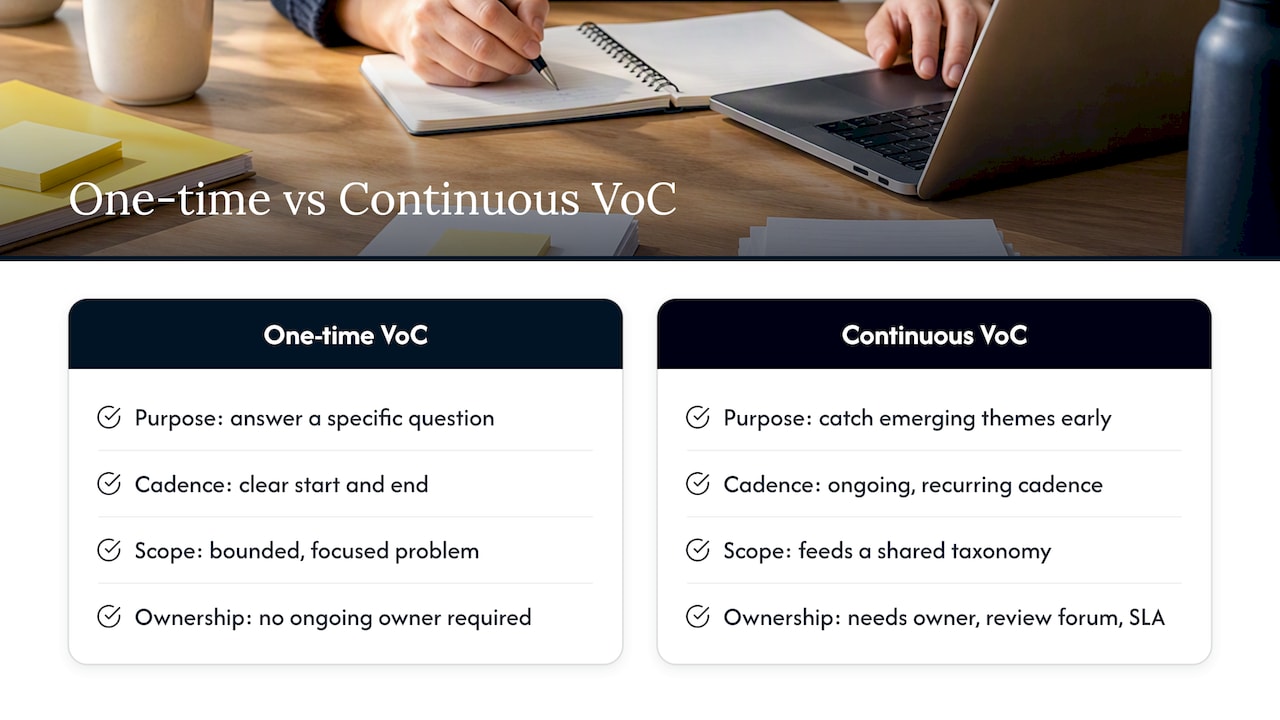
A one-time VoC project can answer a specific question: why did churn spike last quarter, or why did a product launch underperform. It has a clear start and end, and it is useful when you need a fast answer to a bounded problem.
A continuous VoC program is a different commitment. It runs on an ongoing cadence, feeds a shared taxonomy, and compounds in value over time because you start catching emerging themes before they become expensive problems. The tradeoff is operational: continuous programs need a named owner, a recurring review forum, and a service level agreement for closing the loop, none of which a one-time project requires.
Most organizations are better served by starting with a one-time project focused on the highest-volume channel, support tickets or sales calls are usually the cheapest to start with, then expanding into a continuous program once that first project proves the value. Trying to launch a full continuous program on day one, across every channel, is the most common reason VoC initiatives stall before they produce anything useful.
Segmentation and personalization in VoC data analysis
Aggregate VoC data hides as much as it reveals. A theme that looks minor across your whole customer base might be the single biggest driver of churn among your highest-value segment, and averaging the two together buries that signal.
Segment your VoC analysis by the variables that matter to your business: customer value tier, tenure, product line, or acquisition channel are common starting points. A complaint from a new customer in their first month often points to an onboarding problem, while the same complaint from a five-year customer points to something that changed recently. Treating those as the same theme wastes the most useful part of the signal, which is who is saying it and when.
Personalization follows naturally once segmentation is in place. The language that resonates with a price-sensitive small business buyer is rarely the same language that resonates with an enterprise buyer evaluating risk, even when they are describing the same underlying problem. A VoC program that segments its themes can feed that difference directly into targeted messaging, rather than producing one generic value proposition that tries to speak to everyone and ends up connecting with no one in particular.
Author perspective and realistic next steps for leaders
Most leaders overbuild their first VoC effort. Start with support tickets and sales calls, you already have that language sitting in your systems for free, before you fund a broad survey. Set a short closed-loop deadline, 30 days is reasonable, and put a monthly review on the calendar before you collect a single new response. A 30-day sprint through the steps in this guide will tell you more than a perfect plan that never launches.
— Fadly
How Hockworks helps: homepage blueprints informed by VoC
Most service businesses already have the customer language they need, it is sitting in support tickets, sales notes, and reviews, but it never makes it onto the homepage where it would do the most good. Hockworks builds a conversion focused blueprint that takes that language and turns it into a messaging map, a proof placement plan, and an implementation checklist your team can act on without a full redesign.
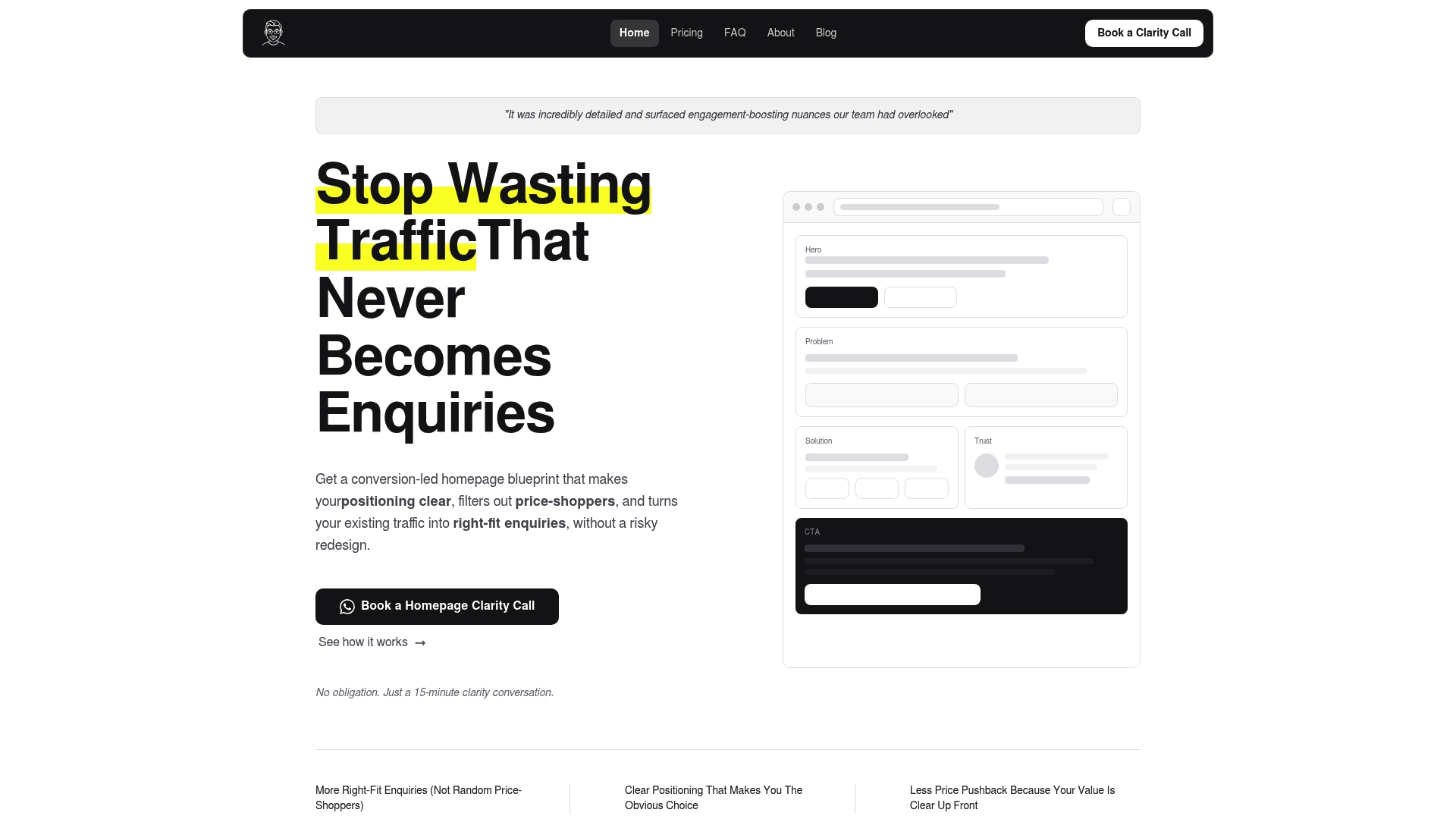
- Homepage diagnosis identifies where visitors hesitate before they enquire
- Messaging mapping turns verbatim customer phrases into headline and value proposition tests
- Proof placement and an implementation checklist show exactly where evidence belongs on the page
The result is a plan that helps reduce decision friction and attract more right-fit enquiries. If you want a starting point before committing to a full engagement, a free website review will show you where your current homepage is losing those enquiries, and the full pricing for a homepage blueprint is available when you are ready to move.
FAQ
What is voice of customer research?
Voice of customer research is the structured, multi-channel capture of customers’ own words, through surveys, interviews, support tickets, and reviews, organized into themes that guide business decisions. It differs from a single survey because it combines several data sources and turns them into prioritized, actionable insight rather than a one-time score.
What is a good VOC score?
There is no single universal benchmark for a “good” VoC score, since NPS and CSAT targets vary by industry and customer base. A more reliable signal than the absolute number is whether the score is improving over time alongside a rising closed-loop completion rate, which shows the feedback is actually driving change.
What is VOC in Six Sigma?
In Six Sigma, voice of customer refers to the practice of translating customer requirements and feedback into specific, measurable quality targets that guide process improvement. It serves the same underlying purpose as broader VoC research: turning what customers say into criteria a team can design and measure against.
What is a VOC survey?
A VoC survey is a structured questionnaire, often built around NPS or CSAT, used to measure customer sentiment and gather feedback on a regular cadence. The strongest VoC surveys pair a rating question with an open-ended follow-up, so you capture both the score and the reasoning behind it.
Recommended

About the author
Thiam Hock is the founder of Hockworks, a Singapore-based digital advisory focused on clarity-driven websites. He works with service businesses to design websites that guide decisions, filter the right enquiries and reduce hesitation. His perspective centres on positioning, differentiation and how visitors actually make decisions in competitive markets.
Read more about Thiam Hock →