Turn One Award Into Enquiries on Your Singapore Service Homepage
Show one verifiable award on your Singapore homepage, link to proof, follow issuer rules, and add Organization schema to lift enquiries.

Yes, show a small number of recent, verifiable recognitions in targeted homepage spots: your hero area, a trust strip near the top fold, and a linked proof page for full details. Skip generic or outdated badges, and follow each award’s own usage rules. This kind of proof placement can be built directly into homepage blueprints, and pairing a badge with Organization schema markup helps both visitors and search engines trust what they see.
TL;DR:
- Display only recent, verifiable recognitions such as current certifications and awards from trusted bodies, ensuring easy authentication within thirty seconds.
- Position the most credible badge in the hero area, with additional awards in a clean trust strip below the fold, avoiding clutter and redundancy.
- Follow issuing bodies’ branding and usage rules exactly, linking each badge to its official verification or certification page.
- Disclose if any recognized badge was purchased rather than earned, and avoid using outdated or non-transparent awards to prevent undermining trust.
- Measure recognition effectiveness by tracking inquiry quality and verification click-throughs, retiring badges older than three years to maintain credibility.
Table of Contents
- Which recognitions actually belong on your homepage
- Where to place awards so they reduce friction, not add it
- Presenting awards the right way: logos, copy, and schema
- The legal and brand-usage rules you can’t skip
- Measuring whether your awards are actually working
- What we see most often in homepage audits
- How Hockworks turns recognitions into better enquiries
- FAQ
- Sources
Which recognitions actually belong on your homepage
Not every badge earns a spot above the fold. Some recognitions build trust instantly. Others quietly undermine it.
Four categories are worth considering: official certifications, reputable industry awards, client or partner recognitions, and third-party listings with real verification behind them. A certification like TÜV SÜD PSB carries weight because it’s tied to an audited process, not a popularity contest. An industry award such as the Singapore SME 500 Award works the same way, provided the year is current and the logo is used as issued.
The test is simple: can a skeptical prospect verify this in thirty seconds? If the answer is no, the badge is doing more harm than good.
- Prioritize awards tied to your actual category of work over broad, unrelated ones.
- Favor recognitions issued within the last few years over anything that reads as legacy decoration.
- Choose certifications and awards you can link to an official listing or certificate number.
Watch for red flags: paid-for badges with no transparency about judging criteria, awards from years ago still displayed as if current, and homepages so crowded with logos that none of them register. A single strong recognition, placed well, outperforms six mediocre ones stacked in a row.
Where to place awards so they reduce friction, not add it
Placement decides whether an award builds confidence or just adds visual noise. Treat it as a sequencing problem, not a decoration problem.
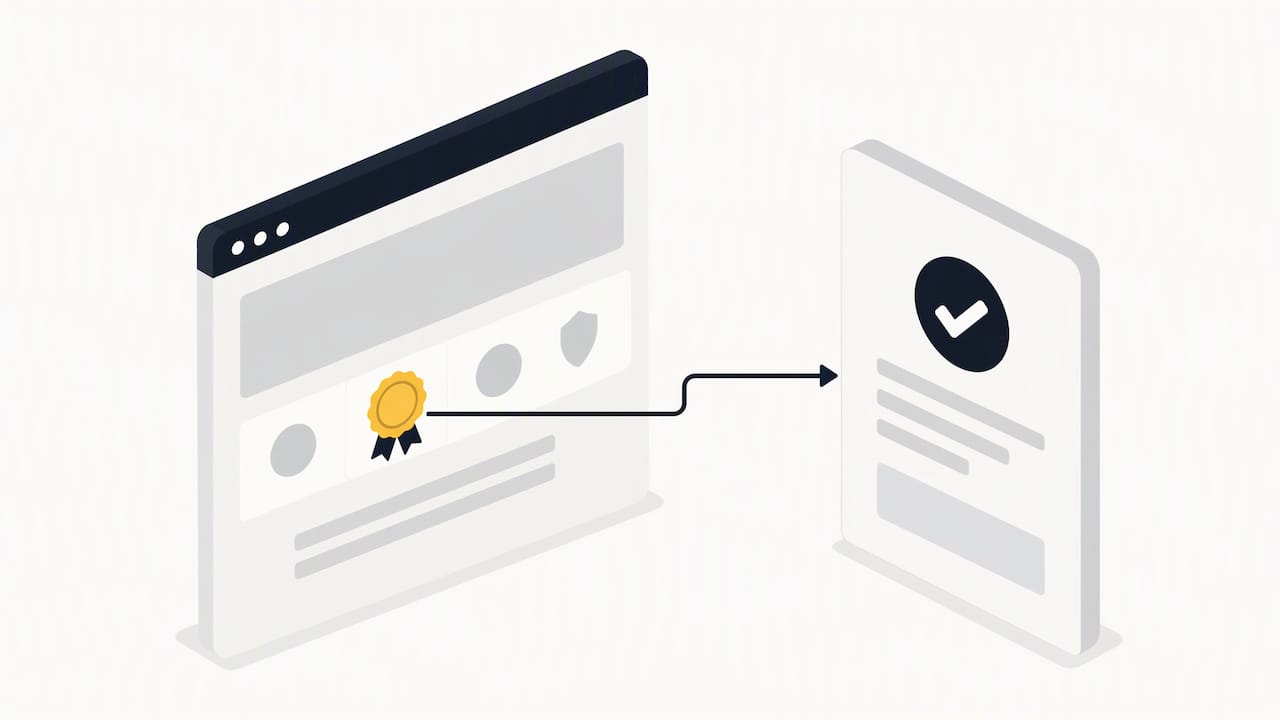
- Use a hero badge only for your single strongest, most recent recognition, the one a prospect would recognize or trust at sight.
- Build a trust strip just below the fold for two or three additional recognitions, shown in a clean row with consistent sizing.
- Reserve your about section or a dedicated proof page for full certificate details, including numbers, dates, and verification links.
- Order badges by relevance to the visitor’s likely concern, not by how impressive the logo looks.
A hero badge next to your headline works when the recognition is instantly credible to your buyer. A trust strip works better when you have several worth showing but none strong enough to lead with alone. Don’t cram five badges into the hero. Don’t bury your best award three scrolls down where nobody sees it.
Pro Tip: Link every badge, even in the trust strip, straight to its verification page. A badge that just sits there invites doubt instead of removing it.
Presenting awards the right way: logos, copy, and schema
Visual presentation and technical setup both matter here, and most businesses get at least one wrong.
On logo usage, follow the issuing body’s rules exactly. Singapore SME 500 Award guidelines specify a minimum logo size for small display areas and require the awarded year to stay visible on the logo at all times. TÜV SÜD PSB requires approval before a certification mark appears publicly and typically expects the certificate number to sit alongside the mark, not buried on a separate page.
- Never alter a badge’s color, proportions, or file, since most award bodies explicitly prohibit it.
- Display the award year clearly rather than letting an old badge imply current status.
- Link each badge to its official listing, certificate, or verification page.
- Add Organization structured data to your homepage, using the
awardproperty and asameAsarray pointing to verified pages.
Trust markers only work when they connect to verifiable evidence elsewhere; an isolated badge with no link can actually increase skepticism rather than reduce it. That single finding explains why so many homepages with impressive-looking badges still underperform on enquiry quality.
Google’s documentation on Organization schema recommends wrapping Organization and WebSite markup together in a single @graph, which gives search engines a clearer map of your brand and its recognitions.
The legal and brand-usage rules you can’t skip
Award logos are licensed, not free assets. Treat them that way.
Singapore SME 500 Award terms permit winners to use the provided Digital Welcome Kit files for promotional purposes, but the files cannot be modified and must be represented with dignity. TÜV SÜD PSB goes further, requiring written approval before a certification mark appears in public and pairing the mark with its unique certificate number.
| Requirement | Singapore SME 500 Award | TÜV SÜD PSB |
|---|---|---|
| Approval needed before use | Implied by terms and conditions | Required before public use |
| Year or certificate number shown | Award year must stay visible | Certificate number required alongside mark |
| File modification allowed | Not permitted | Not permitted |
- Get written approval or confirmation before placing any certification mark on your homepage.
- Follow the issuing body’s color, size, and spacing specifications exactly as published.
- Keep original media files unedited and stored for reference.
- Link every badge to its certificate or official listing page.
Paid recognitions carry extra risk. If a badge was purchased rather than earned through judged criteria, disclose that context somewhere accessible, since implying independent merit when there wasn’t any edges toward misleading advertising.
Measuring whether your awards are actually working
A badge that looks nice but doesn’t move enquiry quality isn’t worth the real estate.
- Track a qualified-enquiry rate alongside your overall conversion rate, not just raw form submissions.
- Run an A/B test with the badge shown to half your traffic and hidden from the other half, for at least a full business cycle.
- Watch clicks through to your proof or certificate page as a secondary signal of engagement.
- Add one qualification question to your enquiry form, such as project size or budget range, to see whether badge exposure shifts who actually reaches out.
Pair the numbers with a quick qualitative check: a short post-contact survey asking new enquiries what made them reach out. If nobody mentions the award, it may be decoration rather than proof.
Pro Tip: Retire or refresh any award older than about three years. A stale badge signals stagnation even when the underlying work is current.
What we see most often in homepage audits
Most homepages don’t misuse awards out of carelessness. They misuse them because nobody revisited the badge after the initial excitement wore off.
The three mistakes I see on repeat: a badge buried below three other sections where nobody scrolls to it, vague copy like “award-winning” with no year or link attached, and logos displayed without any path back to verification. The fix is almost always the same, relocate the badge closer to the decision point, reword the copy to name the actual award and year, and link straight to the certificate or listing. Clients who make these three changes typically see enquiries that match their ideal client profile more closely, not just more enquiries overall. That distinction is the whole point of treating awards as proof rather than wallpaper.
— Fadly
How Hockworks turns recognitions into better enquiries
A badge sitting in the wrong place on your homepage is a small problem compared to the bigger one: most service-business homepages weren’t built around where proof should sit at all. That’s the gap Hockworks closes.
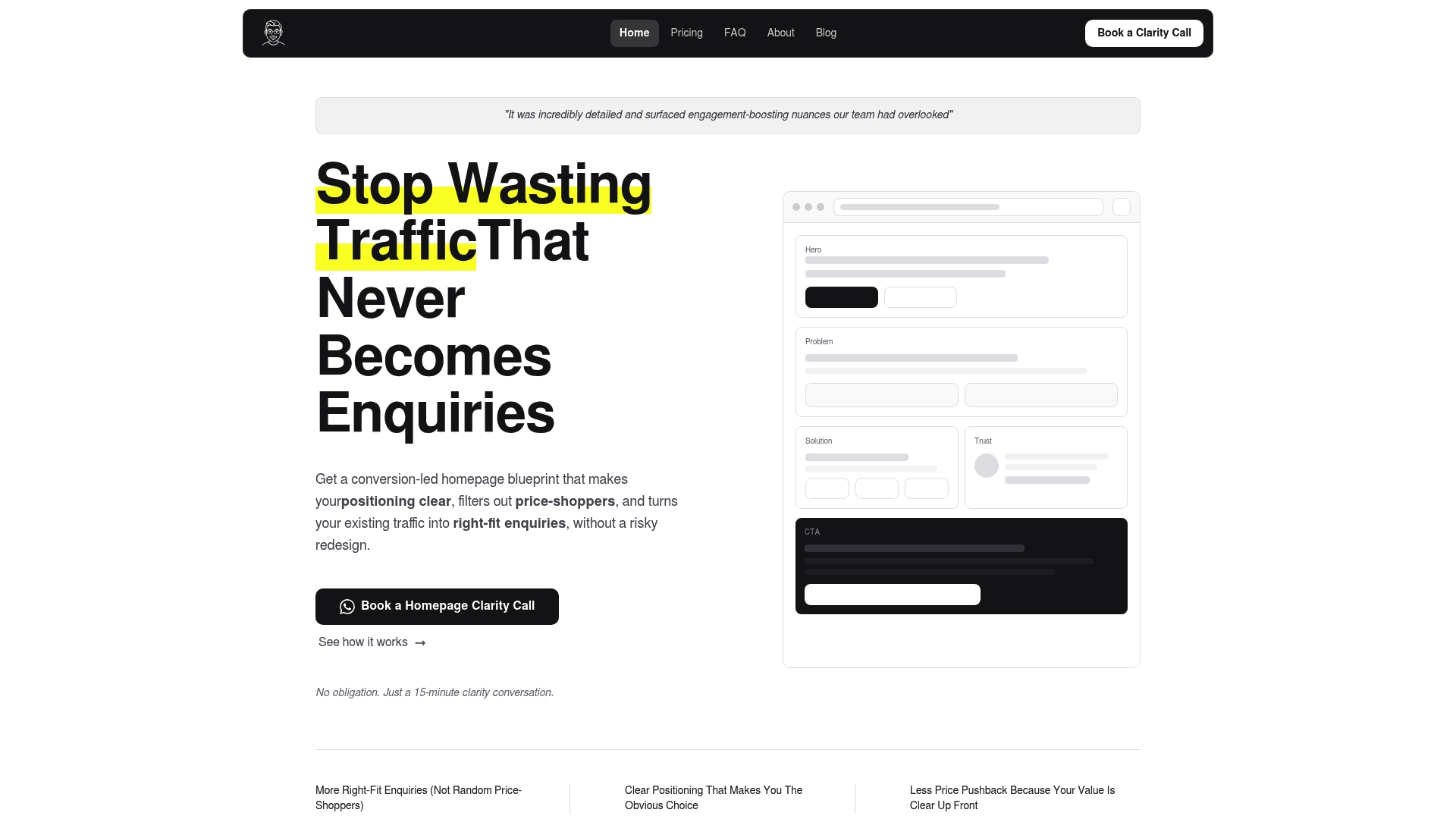
A homepage blueprint can map where certifications, client recognitions, and verification links belong relative to your headline, pricing cues, and call to action, often including a video walkthrough to support implementation without a full redesign. If you’re not ready to commit, the Free Website Review gives you a no-cost look at where your current proof placement is helping or hurting. For businesses that also want their about page tightened around the same story, the Homepage + About package covers both. Start with a homepage blueprint and see exactly where your recognitions should sit.
FAQ
Should every service business display awards on its homepage?
Not every business needs a badge-heavy homepage, but a recent, verifiable recognition placed near the top fold tends to reduce hesitation for prospects evaluating unfamiliar providers. The key is relevance and recency rather than quantity.
How many awards should I show on my homepage?
One strong, current recognition in the hero area plus a few more in a trust strip is usually enough. Beyond that, badges start competing for attention rather than reinforcing trust, and a proof page with full detail serves visitors who want to verify further.
Do I need permission to use an award logo on my site?
Yes. Bodies like the Singapore SME 500 Award and TÜV SÜD PSB both require winners to follow published usage terms, and TÜV SÜD PSB specifically requires approval before any public display of its certification mark.
What is Organization schema and why does it matter for awards?
Organization schema is structured data that tells search engines who your business is, and it includes an award property specifically for recognitions like these. Google’s documentation recommends placing it on your homepage, ideally connected to WebSite schema through a shared @graph.
Can Hockworks help me figure out where to place my awards?
Yes. Hockworks builds proof placement, including award and certification placement, directly into its homepage blueprint engagements, and its Free Website Review is a good starting point if you want a lower-commitment first look.
Sources
- Trademark and Brand Usage Guidelines | Singapore SME 500 Award 2026
- CRT-CP-PM-G-01 - Instructions on the Use of Certificates, Certification and Accreditation Marks
- Organization Schema Markup | Google Search Central | Documentation
- Trustworthy design | Nielsen Norman Group
Recommended

About the author
Thiam Hock is the founder of Hockworks, a Singapore-based digital advisory focused on clarity-driven websites. He works with service businesses to design websites that guide decisions, filter the right enquiries and reduce hesitation. His perspective centres on positioning, differentiation and how visitors actually make decisions in competitive markets.
Read more about Thiam Hock →